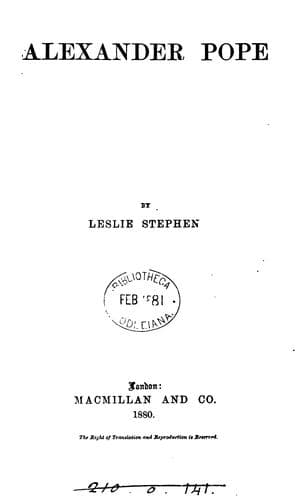
Poets, English -- 18th century -- Biography; Pope, Alexander, 1688-1744
After making all such deductions, it would still seem that the bare fact
that he was working in a generally accepted style gave Pope a very
definite advantage. He spoke more or less in a falsetto, but he could at
once strike a key intelligible to his audience. An earlier poet would
simply annex Homer's gods and fix them with a mediaeval framework. A more
modern poet tries to find some style which will correspond to the
Homeric as closely as possible, and feels that he is making an
experiment beset with all manner of difficulties. Pope needed no more to
bother himself about such matters than about grammatical or philological
refinements. He found a ready-made style which was assumed to be
correct; he had to write in regular rhymed couplets, as neatly rhymed
and tersely expressed as might be; and the diction was equally settled.
He was to keep to Homer for the substance, but he could throw in any
little ornaments to suit the taste of his readers; and if they found out
a want of scrupulous fidelity, he might freely say that he did not aim
at such details. Working, therefore, upon the given data, he could
enjoy a considerable amount of freedom, and throw his whole energy into
the task of forcible expression without feeling himself trammelled at
every step. The result would certainly not be Homer, but it might be a
fine epic poem as epic poetry was understood in the days of Anne and
George I.--a hybrid genus, at the best, something without enough
constitutional vigour to be valuable when really original, but not
without a merit of its own when modelled upon the lines laid down in the
great archetype. When we look at Pope's Iliad upon this understanding,
we cannot fail, I think, to admit that it has merits which makes its
great success intelligible. If we read it as a purely English poem, the
sustained vivacity and emphasis of the style give it a decisive
superiority over its rivals. It has become the fashion to quote Chapman
since the noble sonnet in which Keats, in testifying to the power of the
Elizabethan translator, testifies rather to his own exquisite
perception. Chapman was a poet worthy of our great poetic period, and
Pope himself testifies to the "daring fiery spirit" which animates his
translation, and says that it is not unlike what Homer himself might
have written in his youth--surely not a grudging praise. But though this
is true, I will venture to assert that Chapman also sins, not merely by
his love of quaintness, but by constantly indulging in sheer doggerel.
If his lines do not stagnate, they foam and fret like a mountain brook,
instead of flowing continuously and majestically like a great river. He
surpasses Pope chiefly, as it seems to me, where Pope's conventional
verbiage smothers and conceals some vivid image from nature. Pope, of
course, was a thorough man of forms, and when he has to speak of sea or
sky or mountain generally draws upon the current coin of poetic
Public-domain text, read in full here on John Shaqi.
Reviews
Reviews
No reviews yet
Be the first to share your thoughts on this work.
Join the Discussion
Join the discussion
Sign in to leave a comment or review.
Sign InorCreate an account