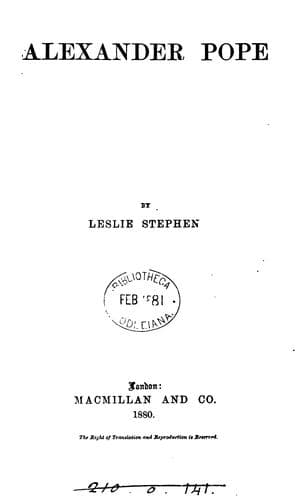
Poets, English -- 18th century -- Biography; Pope, Alexander, 1688-1744
Pope deserves the credit of preserving his independence. He would not
stoop low enough to take a pension at the price virtually demanded by
the party in power. He was not, however, inaccessible to aristocratic
blandishments, and was proud to be the valued and petted guest in many
great houses. Through Swift he had become acquainted with Oxford, the
colleague of Bolingbroke, and was a frequent and intimate guest of the
second Earl, from whose servant Johnson derived the curious information
as to his habits. Harcourt, Oxford's Chancellor, lent him a house
whilst translating Homer. Sheffield, the Duke of Buckingham, had been an
early patron, and after the duke's death, Pope, at the request of his
eccentric duchess, the illegitimate daughter of James II., edited some
of his works and got into trouble for some Jacobite phrases contained in
them. His most familiar friend among the opposition magnates was Lord
Bathurst, a man of uncommon vivacity and good-humour. He was born four
years before Pope, and died more than thirty years later at the age of
ninety-one. One of the finest passages in Burke's American speeches
turns upon the vast changes which had taken place during Bathurst's
lifetime. He lived to see his son Chancellor. Two years before his death
the son left the father's dinner-table with some remark upon the
advantage of regular habits. "Now the old gentleman's gone," said the
lively youth of eighty-nine to the remaining guests, "let's crack the
other bottle." Bathurst delighted in planting, and Pope in giving him
advice, and in discussing the opening of vistas and erection of temples,
and the poet was apt to be vexed when his advice was not taken.
Another friend, even more restless and comet-like in his appearances,
was the famous Peterborough, the man who had seen more kings and
postilions than any one in Europe; of whom Walsh injudiciously remarked
that he had too much wit to be entrusted with the command of an army;
and whose victories soon after the unlucky remark had been made, were so
brilliant as to resemble strategical epigrams. Pope seems to have been
dazzled by the amazing vivacity of the man, and has left a curious
description of his last days. Pope found him on the eve of the voyage in
which he died, sick of an agonizing disease, crying out for pain at
night, fainting away twice in the morning, lying like a dead man for a
time, and in the intervals of pain giving a dinner to ten people,
laughing, talking, declaiming against the corruption of the times,
giving directions to his workmen, and insisting upon going to sea in a
yacht without preparations for landing anywhere in particular. Pope
seems to have been specially attracted by such men, with intellects as
restless as his own, but with infinitely more vitality to stand the
consequent wear and tear.
Public-domain text, read in full here on John Shaqi.
Reviews
Reviews
No reviews yet
Be the first to share your thoughts on this work.
Elsewhere in the archive
Join the Discussion
Join the discussion
Sign in to leave a comment or review.
Sign InorCreate an account