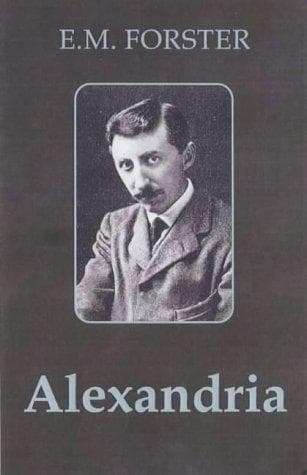
Alexandria: A History and a GuideForster, E. M. (Edward Morgan)
History
Alexandria: A History and a Guide
Forster, E. M. (Edward Morgan)
Alexandria (Egypt) -- Guidebooks; Alexandria (Egypt) -- History
(i). HISTORY OF THE CAESAREUM.—Cleopatra began it in honour of
Antony (p. 26). After their suicide Octavian finished it in honour
of himself. (B.C. 13). He was worshipped there as Caesar Augustus,
and the temple remained an imperial possession until Christian
times. Constantius II (A.D. 354) intended to present it to the
Church, but before the transference could be effected St.
Athanasius, who was always energetic, had held an Easter Service
inside it. The Emperor was offended. Two years later his troops
nearly killed Athanasius inside the building, and gave it to the
Arians. Arians and Orthodox continued to fight for and in it and
smashed it to pieces. (p. 49). Athanasius, just back from his final
exile, built on the ruins a church which was dedicated to St.
Michael but usually retained the famous title Caesareum. It became
the Cathedral of Alexandria, superseding St. Theonas (p. 189). Here
in 416 Hypatia was torn to pieces by tiles (p. 51). Here in 640 the
Patriarch Cyrus held a solemn service before betraying the city to
the Arabs (p. 55). Date of final destruction—912.
(ii). APPEARANCE. Nothing is known of the architecture of the
temple, but the Jewish philosopher Philo (p. 63) thus writes of it
in the day of its glory:
“It is a piece incomparably above all others. It stands by a
most commodious harbour: wonderful high and large in proportion;
an eminent sea-mark: full of choice paintings and statues with
donatives and oblatives in abundance; and then it is beautiful
all over with gold and silver; the model curious and regular in
the disposition of the parts, as galleries, libraries, porches,
courts, halls, walks, and consecrated groves, as glorious as
expense and art could make them, and everything in the proper
place; besides that, the hope and comfort of seafaring men,
either coming in or going out.”
(iii). THE OBELISKS. In front of the Caesareum (between present tram
terminus and sea) stood “Cleopatra’s Needles” of which one is now in
the Central Park, New York, and the other on the Embankment, London,
They had nothing to do with Cleopatra till after her death. They
were cut in the granite quarries of Assouan for Thothmes III (B.C.
1500), and set up by him at Heliopolis near Cairo, before the temple
of the Rising Sun. In B.C. 13 they were transferred here by the
engineer Pontius. They rested not directly on their bases but each
on four huge metal crabs, one of which has been recovered. Statues
of Hermes or of Victory tipped them. In the Arab period, when all
around decayed, they became the chief marvel of the city. One fell.
They remained in situ until the 19th cent., when they were parted
and took their last journey, the fallen one to England in 1877, the
other to the United States two years later.
Public-domain text, read in full here on John Shaqi.
Reviews
Reviews
No reviews yet
Be the first to share your thoughts on this work.
Elsewhere in the archive
Join the Discussion
Join the discussion
Sign in to leave a comment or review.
Sign InorCreate an account