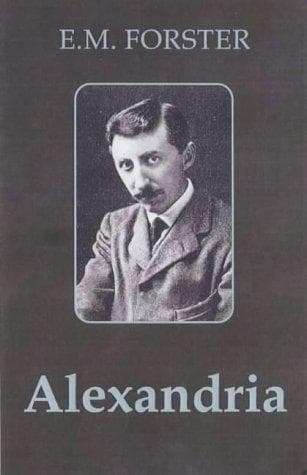
Alexandria: A History and a GuideForster, E. M. (Edward Morgan)
History
Alexandria: A History and a Guide
Forster, E. M. (Edward Morgan)
Alexandria (Egypt) -- Guidebooks; Alexandria (Egypt) -- History
-------
GUIDE.
------------------------------------------------------------------------
SECTION I.
-------
FROM THE SQUARE TO THE Rue Rosette.
ROUTE:—Square, Rue Chérif Pacha, Rue Rosette, leading through the most
modern section of the town. No tram line.
* * * * *
CHIEF POINTS OF INTEREST:—Square and Statue of Mohammed Ali; Banco di
Roma; Mosque of the Prophet Daniel; St. Saba; Greco-Roman Museum.
THE SQUARE.
_The Square_ (officially, Place Mohammed Ali; formerly Place des
Consuls; known to cabmen as “Menschieh” from the adjoining Police
Station) was laid out by Mohammed Ali as the centre of his new city.
(About 1830; see p. 92). In Ptolemaic times the ground here was under
the sea. The Square is over 100 yds. broad and nearly 500 long and well
planted, but unworthy buildings surround it. It suffered in the riots of
1882 (p. 95.) everything was then burnt excepting the statue of Mohammed
Ali and the Church of St. Mark.
In the Centre:—_Equestrian Statue of Mohammed Ali_, an impressive
specimen of French Sculpture, by Jacquemart, exhibited in the Salon of
1872. Orthodox Mohammedans were hostile to its erection, and even now
there is no inscription on it. Its presence is the more welcome since it
is one of the few first class objects in the city. It should be studied
from every point of view.
Right as one faces the Statue:—_The Mixed Tribunals_, where, in
accordance with arrangements dating from 1875, civil and commercial
cases between Egyptians and Europeans are tried.
Left:—_The French Gardens_, a pleasant strip, stretching at right angles
from the Square to the New Quays, (p. 140).
Also left:—_Anglican Church of St. Mark_, which with the adjacent St.
Mark’s Buildings was built on land granted to the English by Mohammed
Ali. Looking through the railings of the church-yard is the funny little
bust of General Earle (k. 1885 at Kirbekan in the Soudan). It was
erected by the European Community, and represents their chief incursion
into the realms of art. The Church itself, considering its date (1855),
and its pseudo-Byzantine architecture, is however a tolerable building.
The interior is restful and the stained glass and triptych in the
chancel strike a pleasing note of colour. Historically, its only
associations are with the fighting against Arabi in 1882 (p. 93). The
Regiments it commemorates are the 2nd Bn. Duke of Cornwall’s Light
infantry (on the scroll by the entrance stairs); 2nd. Bn. Derbyshires;
Royal Marine Artillery; 1st. Bn. London Division; Royal Artillery 1st
Bn. Royal West Kents (in the Nave). In the churchyard trees
multitudinous, sparrows gather at sunset, and fill the Square with their
chatter.
Public-domain text, read in full here on John Shaqi.
Reviews
Reviews
No reviews yet
Be the first to share your thoughts on this work.
Elsewhere in the archive
Join the Discussion
Join the discussion
Sign in to leave a comment or review.
Sign InorCreate an account