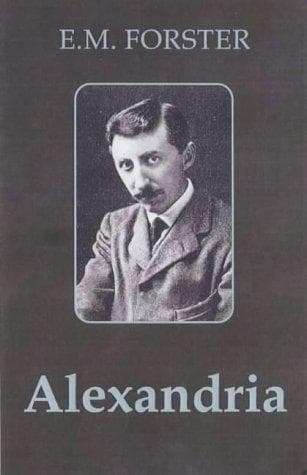
Alexandria: A History and a GuideForster, E. M. (Edward Morgan)
History
Alexandria: A History and a Guide
Forster, E. M. (Edward Morgan)
Alexandria (Egypt) -- Guidebooks; Alexandria (Egypt) -- History
End of the Square:—_The Bourse_, with arcaded exterior and clock. Inside
is the Cotton Exchange, the chief in the Egyptian trade; the howls and
cries that may be heard here of a morning proceed not from a menagerie
but from the wealthy merchants of Alexandria as they buy and sell. At
the other end of the same hall is the Stock Exchange. The whole scene is
well worth a visit (introduction necessary).
* * * * *
_Rue Chérif Pacha_, a smart little street bristling with flag staffs,
leads out of the Square to the left of the Bourse. Here are the best
shops. Towards the end, left, at the entrance of the Rue Toussoum Pacha,
is the _Banco di Roma_, the finest building in the city. Architect,
Gorra. A modified copy of the famous Palazzo Farnese, which Antonio da
San Gallo and Michelangelo built in the 16th cent., at Rome. The
materials are artificial stone and narrow bricks of a charming pale red.
It has two stories as against the Farnese’s three, but there is a sort
of half storey up under the heavy cornice. Each side of the door are
elaborate torch holders of bent iron; over door, the Wolf of Rome. In a
cosmopolitan city like Alexandria, which has never evolved an
architecture of its own, there is nothing incongruous in this copy of
the Italian Renaissance. A little further up Rue Toussoum Pacha is the
_Land Bank of Egypt_, with a good semi-circular portico.
Rue Chérif Pacha then joins the Rue Rosette.
Rue Rosette.
This street, despite its modern appearance, is the most ancient in the
city. It runs on the lines of the Canopic Way, the central artery of
Alexander’s town, (p. 10), and under the Ptolemies it was lined from end
to end with marble colonnades. Its full title is “Rue de la Porte
Rosette” from the Rosetta Gate in the old Arab walls through which it
passed out eastwards (p. 81). The Municipality have recently changed its
name to the unmeaning Rue Fouad Premier, thus breaking one of the few
links that bound their city to the past.
At its entrance, right, are:—the Caracol Attarine (British Main Guard);
the Rue de la Gare du Caire, leading to the main railway station; and
the Mohammed Ali Club, the chief in the town—a small temple to Serapis
once stood on its site. Here too is Cook’s office.
100 yds. down it is crossed by the Rue Nebi Daniel and by a tramway.
Here, in ancient times, was the main crossway of the ancient city—one of
the most glorious places in the world (p. 10). Achilles Tatius, a bishop
who in A.D. 400 wrote a somewhat foolish and improper novel called
Clitophon and Leucippe, thus describes it:—
Public-domain text, read in full here on John Shaqi.
Reviews
Reviews
No reviews yet
Be the first to share your thoughts on this work.
Elsewhere in the archive
Join the Discussion
Join the discussion
Sign in to leave a comment or review.
Sign InorCreate an account