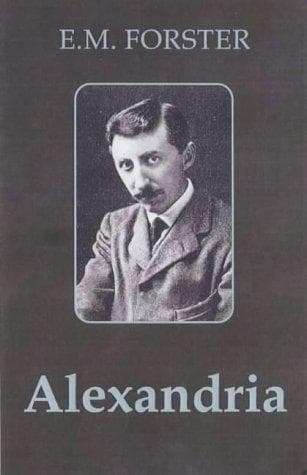
Alexandria: A History and a GuideForster, E. M. (Edward Morgan)
History
Alexandria: A History and a Guide
Forster, E. M. (Edward Morgan)
Alexandria (Egypt) -- Guidebooks; Alexandria (Egypt) -- History
The first thing one noticed in entering Alexandria by the Gate of
the Sun (i.e. by the Rosetta Gate) was the beauty of the city. A
range of columns went from one end of it to the other. Advancing
down them, I came in time to the place that bears the name of
Alexander, and there could see the other half of the town, which was
equally beautiful. For just as the colonnades stretched ahead of me,
so did other colonnades now appear at right angles to them.
Thus the tramway was also lined with marble once.
Turning to the right, a few yards up the Rue Nebi Daniel, we come
to:—_The Mosque of the Prophet Daniel_ which stands on the site of
Alexander’s tomb—the “Soma” where he and some of the Ptolemies lay,
buried in the Macedonian fashion (p. 19). The cellars have never been
explored, and there is a gossipy story that Alexander still lies in one
of them, intact: a dragoman from the Russian Consulate, probably a liar,
said in 1850 that he saw through a hole in a wooden door “a human body
in a sort of glass cage with a diadem on its head and half bowed on a
sort of elevation or throne. A quantity of books or papyrus were
scattered around.” The present Mosque, though the chief in the city, is
uninteresting; a paved approach, a white washed door, a great interior
supported by four colonnades with slightly pointed arches. The praying
niche faces south instead of the usual east. All has been mercilessly
restored. Stairs lead down to two tombs, assigned to the Prophet Daniel
and to the mythical Lukman the Wise; it is uncertain why or when such a
pair visited our city. The tombs stand in a well-crypt of cruciform
shape, above which is a chapel roofed by a dome and entered from the
mosque through a door. Here and there some decorations struggle through
the whitewash.
In a building to the right of the approach to the Mosque are the _Tombs
of the Khedivial Family_, worth seeing for their queerness; there is
nothing like them in Alexandria. The Mausoleum is cruciform, painted to
imitate marble, and covered with Turkish carpets. Out of the carpet rise
the tombs, of all sizes but of similar design, and all painted white and
gold. A red tarboosh indicates a man, a crown with conventionalised hair
a woman. The most important person buried here is Said Pacha—third tomb
on the right. He was the son of Mohammed Ali and ruled Egypt 1854-1863:
Mohammed Ali himself lies at Cairo.
Between the Mausoleum and the street:—a fountain with eaves and a dome;
Turkish style.
Opposite the Mosque:—some antique columns used as gate posts; perhaps
the facade of the Mouseion stretched along here (p. 17).
Public-domain text, read in full here on John Shaqi.
Reviews
Reviews
No reviews yet
Be the first to share your thoughts on this work.
Elsewhere in the archive
Join the Discussion
Join the discussion
Sign in to leave a comment or review.
Sign InorCreate an account