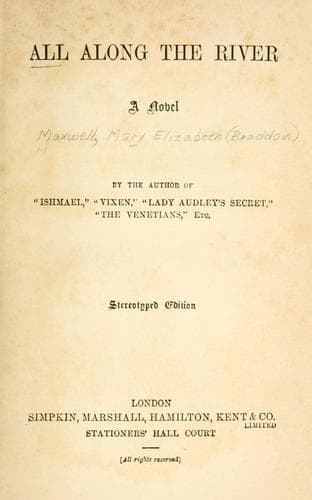
All along the River: A NovelBraddon, M. E. (Mary Elizabeth)
General
All along the River: A Novel
Braddon, M. E. (Mary Elizabeth)
English fiction -- 19th century
The occasion never did present itself. The one English club existent
at Dinan in those days was amply provided with the secretarial
element. There was nothing in Dinan for an Englishman to manage; no
English agency required. Colonel Manwaring settled down into a kind
of somnolent submission to obscure fortunes. He liked the old town,
and he liked the climate. He liked the cooking, and he liked being
out of the way of all the people he knew, and whose vicinity would
have obliged him to live up to a certain conventional level. He liked
to get his English newspapers upon French soil, and it irked him not
that they were thirty-six hours old. He liked to bask in the sunshine
on the terrace above the Rance, or in the open places of the town. He
liked talking of the possibilities of an impending war, in very dubious
French, with the French officers, whose acquaintance he made at club
or café. He had sold his commission and sunk the proceeds of the sale
upon an annuity. He had a little income of his own, and his wife had
a little money from a maiden aunt, and these resources just enabled
him to live with a certain unpretending comfort. He had a good Breton
cook, and an old Scotch valet and butler, who would have gone through
fire and water for his master. Mrs. Manwaring was a thoroughly negative
character, placid as summer seas, sympathetic and helpless. She let
Macgregor and Antoinette manage the house for her, do all the catering,
pay all the bills, and work the whole machinery of her domestic life.
She rejoiced in having a good-tempered husband and obedient daughters.
She had no boys to put her in a fever of anxiety lest they should be
making surreptitious ascents in balloons or staking their little all
upon Zero at the “Etablissement” at Dinard. In summer she sat all day
in one particular south window, knitting stockings for the colonel
and reading the English papers. In winter she occupied herself in the
same manner by the chimney corner. She devoted one day in the week
to writing long letters to distant relatives. Once a day, weather
permitting, she took a gentle constitutional walk upon the terrace
above the Rance, with one of her daughters. Needless to say that in
this life of harmless apathy she had grown very stout, and that she
had forgotten almost every accomplishment of her girlhood.
Public-domain text, read in full here on John Shaqi.
Reviews
Reviews
No reviews yet
Be the first to share your thoughts on this work.
Join the Discussion
Join the discussion
Sign in to leave a comment or review.
Sign InorCreate an account