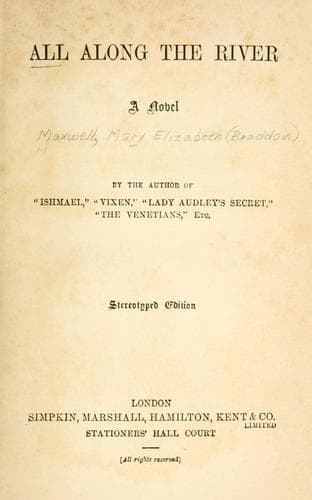
All along the River: A NovelBraddon, M. E. (Mary Elizabeth)
General
All along the River: A Novel
Braddon, M. E. (Mary Elizabeth)
English fiction -- 19th century
From the placid monotony of life in Brittany to the placid monotony of
life in Cornwall, was not a startling transition; yet when she married
Martin Disney, and bade her commonplace father and her apathetic mother
good-bye, Isola felt as if she had escaped from stagnation into a fresh
and vigorous atmosphere. Disney’s character made all the difference.
He was every inch a soldier, a keen politician, a man who had seen
many countries and read many books, clear-brained, strong-willed,
energetic, self-reliant. She felt what it was to belong to somebody
who was capable of taking care of her. She trusted him implicitly; and
she loved him with as deep a love as a girl of nineteen is capable of
feeling for any lover. It may be that the capacity for deep feeling
is but half developed at that age, and in that one fact may be found
the key to many domestic mysteries; mysteries of unions which begin
in the gladness and warmth of responsive affection, and which, a few
years later, pass into a frozen region of indifference or are wrecked
on sunken rocks of guilty passion. Certain it was that Isola Manwaring
gave her hand to this grave, middle-aged soldier, in all the innocence
of a first love; and the love with which he rewarded her confidence,
the earnest watchful love of a man of mature years, was enough for her
happiness. That honeymoon time, that summer of installation in the
Cornish cottage, and then the leisurely journey to Venice in the waning
brilliance of a southern October, seemed like one long happy dream, as
she looked back upon it now, after a year of solitude.
The doctor had decided that, in the delicate health in which she found
herself at the end of that summer, it would be dangerous for her to
accompany her husband to India, more especially as a campaign in Burmah
meant roughing it, and she would in all probability have been separated
from him in the East; so they bade each other a sad good-bye at Venice,
and Isola travelled quickly homeward, all possible comfort having been
secured for her on the way, by her husband’s forethought. It had been
a long, sad, sleepy journey, through a rain-blurred landscape, and she
was glad when the evening of the fourth day brought her to the snug
little dining-room in the Angler’s Nest, where Tabitha was waiting
for her with a cheerful fire and the amber-shaded reading lamp, and
the most delightful little composite meal of chicken and tongue, and
tart, and cream, and tea. It was pleasant to be among familiar things,
after that long journey in stuffy ladies’ carriages, with elderly
invalids, whose chief talk was of their ailments. Pleasant to see the
Shah’s solemn sea-green eyes staring at her, and to have to repulse the
demonstrative attentions of Tim, who leapt upon her lap and licked her
face vehemently every time he caught her off her guard.
She was ill and broken down after her journey, and that sad parting,
and she hid her tears upon Tabitha’s comfortable arm.
Public-domain text, read in full here on John Shaqi.
Reviews
Reviews
No reviews yet
Be the first to share your thoughts on this work.
Join the Discussion
Join the discussion
Sign in to leave a comment or review.
Sign InorCreate an account