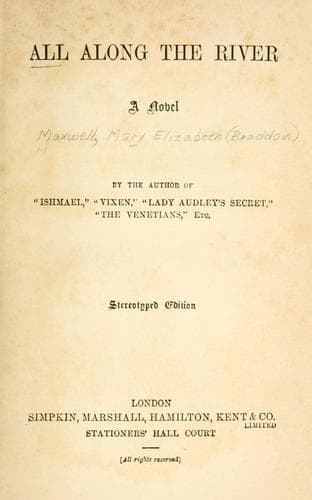
All along the River: A NovelBraddon, M. E. (Mary Elizabeth)
General
All along the River: A Novel
Braddon, M. E. (Mary Elizabeth)
English fiction -- 19th century
“Has she told him?” he wondered, studying her from his place in the
shadow as the lamplight shone full upon her wasted features and hectic
colouring. “Has she taken courage and confessed her sin to that loyal,
loving husband, and is the burden lifted from her heart?”
No; he could not believe that she had lifted the veil from the sad
secret of her past. Martin Disney’s unclouded brow to-night was not
that of a man who had lately discovered that the wife he loved had
betrayed him. There might be pardon--there might be peace between
husband and wife after such a revelation; but there could not be the
serenity which marked Martin Disney’s manner to his wife to-night. Such
a thunder-clap must leave its brand upon the man who suffered it. No;
her secret was still locked in her impenitent heart. Sorry--yes. She
had drunk the cup of remorse in all its bitterness; but she knew not
true penitence, the Christian’s penitence, which means self-abasement
and confession. And yet she seemed happier. There was a look of almost
holy resignation upon the pale and placid brow, and in the too-lustrous
eyes. Something had happened--some moral transformation which made her
a new being.
Father Rodwell drew his chair nearer to her, and looked at her
earnestly with his cordial, almost boyish smile. He was a remarkably
young-looking man, a man upon whom long years of toil in the dark
places of the earth had exercised no wasting or withering influence. He
had loved his work too well ever to feel the pressure of the burdens
he carried. His gospel had been always a cheerful gospel, and he had
helped to lighten sorrows, never to make them heavier. He was deeply
interested in Isola, and had been watchful of all her changes of mood
since their conversation in the shadow of the old Roman wall. He
had seen her impressed by the history and traditions of the church,
moved by the pathos of holy lives, touched almost to tears by sacred
pictures, and he saw in her character and disposition a natural bent
towards piety, exactly that receptive temperament which moves holy
women to lives of self-abnegation and heroic endeavour. He had lent
her some of those books which he loved best and read most himself,
and he had talked with her of religion, careful not to say too much
or with too strong an emphasis, and never by any word alluding to her
revelation of past guilt. He wanted to win her to perfect trustfulness
in him, to teach her to lean upon him in her helplessness; until the
hour should come when she would let him lead her to her husband, in the
self-abasement of the penitent sinner.
Public-domain text, read in full here on John Shaqi.
Reviews
Reviews
No reviews yet
Be the first to share your thoughts on this work.
Elsewhere in the archive
Join the Discussion
Join the discussion
Sign in to leave a comment or review.
Sign InorCreate an account