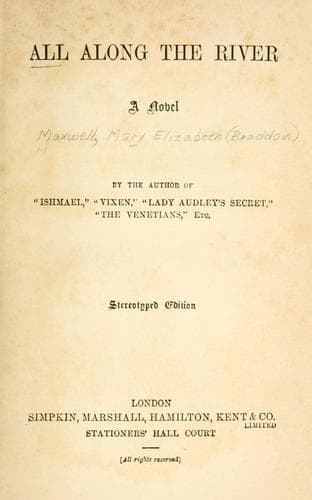
All along the River: A NovelBraddon, M. E. (Mary Elizabeth)
General
All along the River: A Novel
Braddon, M. E. (Mary Elizabeth)
English fiction -- 19th century
She ran on breathlessly as she seated herself by that reclining figure
with the waxen face. It may be that she talked to hide the shock she
had experienced on seeing the altered looks of the young mistress whose
roof she had left in the hour of shame. She had left her, refusing to
hold commune with one who had sinned so deeply. The faithful servant
had taken leave of her mistress in words that had eaten into Isola’s
heart, as if they had been written there with a corrosive acid.
“I am very sorry for you, Mrs. Disney,” she said. “You are young and
pretty, and you are very much to be pitied--and God knows I have loved
you as if you were my own flesh and blood. But I won’t stay under the
roof of a wife who has brought shame upon herself and has dishonoured
the best of husbands.”
Isola had denied nothing, had acknowledged nothing, and had let Tabitha
go. And now they met again for the first time after that miserable
parting, and the servant’s eyes were full of pitying tears, and the
servant’s lips spoke only gentlest words. What a virtue there must be
in death, when so much is forgiven to the dying!
Martin Disney went out with the priest, but at the corner of the Piazza
he stopped abruptly.
“Isola’s coughing fit has upset me more than it has her,” he said; “I’m
not fit company for any one, so I think I’ll go for a tramp somewhere,
and meet you later at dinner, when I’ve recovered my spirits a little.”
“_A riverderci_,” said the priest, grasping his hand. “I felicitate you
upon this day’s union; a happy one, or I am no judge of men and women.”
“I don’t know,” Disney answered gloomily. “The woman is true as
steel--the man comes of a bad stock. You know what the Scripture says
about the tree and the fruit.”
“There never was a race yet that was altogether bad,” said the priest.
“Virtues may descend from remote ancestors as well as vices,--I think
you told me moreover that Captain Hulbert’s mother was a good woman.”
“She was. She was one of my mother’s earliest and dearest friends.”
“Then you should have a better opinion of her son. If ever I met a
thoroughly good fellow in my life, I believe I met one the day I made
Captain Hulbert’s acquaintance.”
“Pray God you may be right,” said Disney, with a sigh. “I am no judge
of character.”
He turned abruptly, and skirted the hill on his way to the gardens of
the Villa Borghese, where he found shade and seclusion in the early
afternoon. The carriages of fashionable Rome had not yet begun to drive
in at the gate. The cypress avenues, the groves of immemorial ilex,
the verdant lawns where the fountains leapt sunward, were peopled only
by creatures of fable, fixed in marble, faun and dryad, hero and god.
Martin Disney plunged into the shadow of one of those funereal avenues,
and--while the sun blazed in almost tropical splendour upon the open
lawn in the far distance--he walked as it were in the deep of night, a
night whose gloom harmonized with that darker night in his despairing
heart.
Public-domain text, read in full here on John Shaqi.
Reviews
Reviews
No reviews yet
Be the first to share your thoughts on this work.
Elsewhere in the archive
Join the Discussion
Join the discussion
Sign in to leave a comment or review.
Sign InorCreate an account