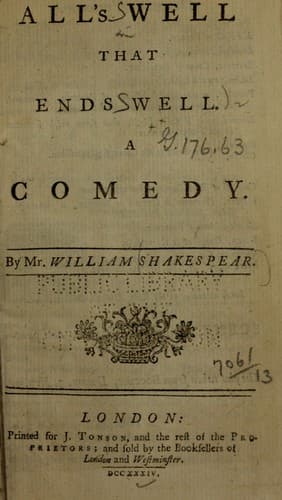
Comedy plays; Florence (Italy) -- Drama; Married women -- Drama; Runaway husbands -- Drama
PAROLLES.
There’s little can be said in’t; ’tis against the rule of nature. To
speak on the part of virginity is to accuse your mothers; which is most
infallible disobedience. He that hangs himself is a virgin: virginity
murders itself, and should be buried in highways out of all sanctified
limit, as a desperate offendress against nature. Virginity breeds
mites, much like a cheese; consumes itself to the very paring, and so
dies with feeding his own stomach. Besides, virginity is peevish,
proud, idle, made of self-love, which is the most inhibited sin in the
canon. Keep it not; you cannot choose but lose by’t. Out with’t! Within
the year it will make itself two, which is a goodly increase, and the
principal itself not much the worse. Away with it!
HELENA.
How might one do, sir, to lose it to her own liking?
PAROLLES.
Let me see. Marry, ill, to like him that ne’er it likes. ’Tis a
commodity will lose the gloss with lying; the longer kept, the less
worth. Off with’t while ’tis vendible; answer the time of request.
Virginity, like an old courtier, wears her cap out of fashion, richly
suited, but unsuitable, just like the brooch and the toothpick, which
wear not now. Your date is better in your pie and your porridge than in
your cheek. And your virginity, your old virginity, is like one of our
French wither’d pears; it looks ill, it eats drily; marry, ’tis a
wither’d pear; it was formerly better; marry, yet ’tis a wither’d pear.
Will you anything with it?
HELENA.
Not my virginity yet.
There shall your master have a thousand loves,
A mother, and a mistress, and a friend,
A phoenix, captain, and an enemy,
A guide, a goddess, and a sovereign,
A counsellor, a traitress, and a dear:
His humble ambition, proud humility,
His jarring concord, and his discord dulcet,
His faith, his sweet disaster; with a world
Of pretty, fond, adoptious christendoms
That blinking Cupid gossips. Now shall he—
I know not what he shall. God send him well!
The court’s a learning-place; and he is one.
PAROLLES.
What one, i’ faith?
HELENA.
That I wish well. ’Tis pity—
PAROLLES.
What’s pity?
HELENA.
That wishing well had not a body in’t
Which might be felt, that we, the poorer born,
Whose baser stars do shut us up in wishes,
Might with effects of them follow our friends,
And show what we alone must think, which never
Returns us thanks.
Enter a Page.
PAGE.
Monsieur Parolles, my lord calls for you.
[_Exit Page._]
PAROLLES.
Little Helen, farewell. If I can remember thee, I will think of thee at
court.
HELENA.
Monsieur Parolles, you were born under a charitable star.
PAROLLES.
Under Mars, I.
HELENA.
I especially think, under Mars.
PAROLLES.
Why under Mars?
HELENA.
The wars hath so kept you under, that you must needs be born under
Mars.
PAROLLES.
When he was predominant.
HELENA.
When he was retrograde, I think rather.
PAROLLES.
Why think you so?
HELENA.
You go so much backward when you fight.
PAROLLES.
That’s for advantage.
Public-domain text, read in full here on John Shaqi.
Reviews
Reviews
No reviews yet
Be the first to share your thoughts on this work.
Join the Discussion
Join the discussion
Sign in to leave a comment or review.
Sign InorCreate an account