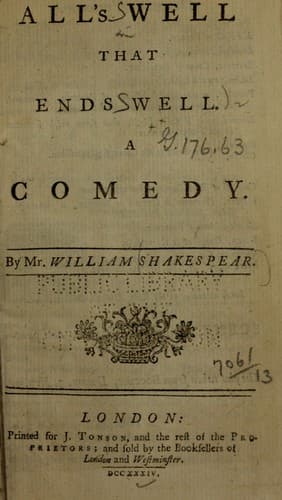
Comedy plays; Florence (Italy) -- Drama; Married women -- Drama; Runaway husbands -- Drama
HELENA.
So is running away, when fear proposes the safety: but the composition
that your valour and fear makes in you is a virtue of a good wing, and
I like the wear well.
PAROLLES.
I am so full of business I cannot answer thee acutely. I will return
perfect courtier; in the which my instruction shall serve to naturalize
thee, so thou wilt be capable of a courtier’s counsel, and understand
what advice shall thrust upon thee; else thou diest in thine
unthankfulness, and thine ignorance makes thee away. Farewell. When
thou hast leisure, say thy prayers; when thou hast none, remember thy
friends. Get thee a good husband, and use him as he uses thee. So,
farewell.
[_Exit._]
HELENA.
Our remedies oft in ourselves do lie,
Which we ascribe to heaven: the fated sky
Gives us free scope; only doth backward pull
Our slow designs when we ourselves are dull.
What power is it which mounts my love so high,
That makes me see, and cannot feed mine eye?
The mightiest space in fortune nature brings
To join like likes, and kiss like native things.
Impossible be strange attempts to those
That weigh their pains in sense, and do suppose
What hath been cannot be. Who ever strove
To show her merit that did miss her love?
The king’s disease,—my project may deceive me,
But my intents are fix’d, and will not leave me.
[_Exit._]
SCENE II. Paris. A room in the King’s palace.
Flourish of cornets. Enter the King of France, with letters; Lords and
others attending.
KING.
The Florentines and Senoys are by th’ ears;
Have fought with equal fortune, and continue
A braving war.
FIRST LORD.
So ’tis reported, sir.
KING.
Nay, ’tis most credible, we here receive it,
A certainty, vouch’d from our cousin Austria,
With caution, that the Florentine will move us
For speedy aid; wherein our dearest friend
Prejudicates the business, and would seem
To have us make denial.
FIRST LORD.
His love and wisdom,
Approv’d so to your majesty, may plead
For amplest credence.
KING.
He hath arm’d our answer,
And Florence is denied before he comes:
Yet, for our gentlemen that mean to see
The Tuscan service, freely have they leave
To stand on either part.
SECOND LORD.
It well may serve
A nursery to our gentry, who are sick
For breathing and exploit.
KING.
What’s he comes here?
Enter Bertram, Lafew and Parolles.
FIRST LORD.
It is the Count Rossillon, my good lord,
Young Bertram.
KING.
Youth, thou bear’st thy father’s face;
Frank nature, rather curious than in haste,
Hath well compos’d thee. Thy father’s moral parts
Mayst thou inherit too! Welcome to Paris.
BERTRAM.
My thanks and duty are your majesty’s.
Public-domain text, read in full here on John Shaqi.
Reviews
Reviews
No reviews yet
Be the first to share your thoughts on this work.
Join the Discussion
Join the discussion
Sign in to leave a comment or review.
Sign InorCreate an account