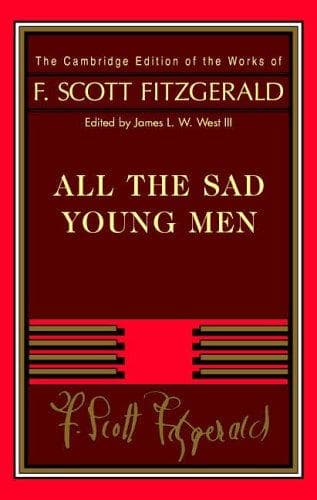
All the Sad Young MenFitzgerald, F. Scott (Francis Scott)
General
All the Sad Young Men
Fitzgerald, F. Scott (Francis Scott)
American fiction -- 20th century; Short stories, American
ALL THE SAD YOUNG MEN
_By_
F. SCOTT FITZGERALD
NEW YORK
CHARLES SCRIBNER'S SONS
1926
TO
RING AND ELLIS LARDNER
CONTENTS
THE RICH BOY
WINTER DREAMS
THE BABY PARTY
ABSOLUTION
RAGS MARTIN-JONES AND THE PR-NCE OF W-LES
THE ADJUSTER
HOT AND COLD BLOOD
"THE SENSIBLE THING"
GRETCHEN'S FORTY WINKS
THE RICH BOY
Begin with an individual, and before you know it you find that you have
created a type; begin with a type, and you find that you have
created--nothing. That is because we are all queer fish, queerer behind
our faces and voices than we want any one to know or than we know
ourselves. When I hear a man proclaiming himself an "average, honest,
open fellow," I feel pretty sure that he has some definite and perhaps
terrible abnormality which he has agreed to conceal--and his
protestation of being average and honest and open is his way of
reminding himself of his misprision.
There are no types, no plurals. There is a rich boy, and this is his and
not his brothers' story. All my life I have lived among his brothers but
this one has been my friend. Besides, if I wrote about his brothers I
should have to begin by attacking all the lies that the poor have told
about the rich and the rich have told about themselves--such a wild
structure they have erected that when we pick up a book about the rich,
some instinct prepares us for unreality. Even the intelligent and
impassioned reporters of life have made the country of the rich as
unreal as fairy-land.
Let me tell you about the very rich. They are different from you and me.
They possess and enjoy early, and it does something to them, makes them
soft where we are hard, and cynical where we are trustful, in a way
that, unless you were born rich, it is very difficult to understand.
They think, deep in their hearts, that they are better than we are
because we had to discover the compensations and refuges of life for
ourselves. Even when they enter deep into our world or sink below us,
they still think that they are better than we are. They are different.
The only way I can describe young Anson Hunter is to approach him as if
he were a foreigner and cling stubbornly to my point of view. If I
accept his for a moment I am lost--I have nothing to show but a
preposterous movie.
II
Anson was the eldest of six children who would some day divide a fortune
of fifteen million dollars, and he reached the age of reason--is it
seven?--at the beginning of the century when daring young women were
already gliding along Fifth Avenue in electric "mobiles." In those days
he and his brother had an English governess who spoke the language very
clearly and crisply and well, so that the two boys grew to speak as she
did--their words and sentences were all crisp and clear and not run
together as ours are. They didn't talk exactly like English children but
acquired an accent that is peculiar to fashionable people in the city of
New York.
Public-domain text, read in full here on John Shaqi.
Reviews
Reviews
No reviews yet
Be the first to share your thoughts on this work.
Join the Discussion
Join the discussion
Sign in to leave a comment or review.
Sign InorCreate an account