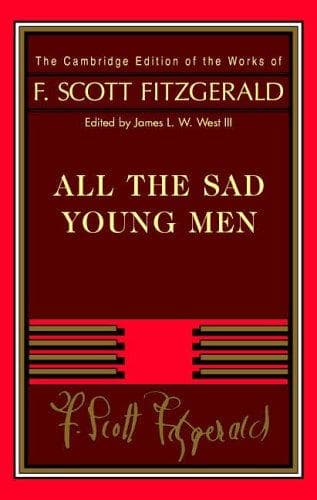
All the Sad Young MenFitzgerald, F. Scott (Francis Scott)
General
All the Sad Young Men
Fitzgerald, F. Scott (Francis Scott)
American fiction -- 20th century; Short stories, American
At the end of the rubber Paula suddenly got up and spoke to Anson in a
tense, low voice. With scarcely a glance at Lowell Thayer, they walked
out the door and descended a long flight of stone steps--in a moment
they were walking hand in hand along the moonlit beach.
"Darling, darling...." They embraced recklessly, passionately, in a
shadow.... Then Paula drew back her face to let his lips say what she
wanted to hear--she could feel the words forming as they kissed
again.... Again she broke away, listening, but as he pulled her close
once more she realized that he had said nothing--only "_Darling_!
_Darling_!" in that deep, sad whisper that always made her cry. Humbly,
obediently, her emotions yielded to him and the tears streamed down her
face, but her heart kept on crying: "Ask me--oh, Anson, dearest, ask
me!"
"Paula.... _Paula_!"
The words wrung her heart like hands, and Anson, feeling her tremble,
knew that emotion was enough. He need say no more, commit their
destinies to no practical enigma. Why should he, when he might hold her
so, biding his own time, for another year--forever? He was considering
them both, her more than himself. For a moment, when she said suddenly
that she must go back to her hotel, he hesitated, thinking, first, "This
is the moment, after all," and then: "No, let it wait--she is mine...."
He had forgotten that Paula too was worn away inside with the strain of
three years. Her mood passed forever in the night.
He went back to New York next morning filled with a certain restless
dissatisfaction. Late in April, without warning, he received a telegram
from Bar Harbor in which Paula told him that she was engaged to Lowell
Thayer, and that they would be married immediately in Boston. What he
never really believed could happen had happened at last.
Anson filled himself with whiskey that morning, and going to the office,
carried on his work without a break--rather with a fear of what would
happen if he stopped. In the evening he went out as usual, saying
nothing of what had occurred; he was cordial, humorous, unabstracted.
But one thing he could not help--for three days, in any place, in any
company, he would suddenly bend his head into his hands and cry like a
child.
V
In 1922 when Anson went abroad with the junior partner to investigate
some London loans, the journey intimated that he was to be taken into
the firm. He was twenty-seven now, a little heavy without being
definitely stout, and with a manner older than his years. Old people and
young people liked him and trusted him, and mothers felt safe when their
daughters were in his charge, for he had a way, when he came into a
room, of putting himself on a footing with the oldest and most
conservative people there. "You and I," he seemed to say, "we're solid.
We understand."
Public-domain text, read in full here on John Shaqi.
Reviews
Reviews
No reviews yet
Be the first to share your thoughts on this work.
Join the Discussion
Join the discussion
Sign in to leave a comment or review.
Sign InorCreate an account