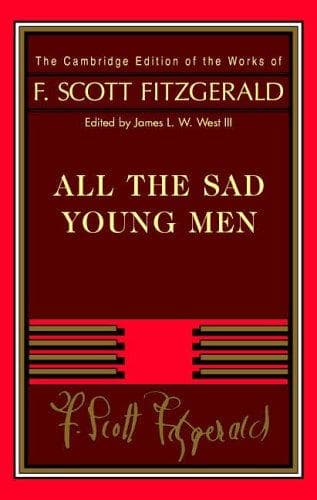
All the Sad Young MenFitzgerald, F. Scott (Francis Scott)
General
All the Sad Young Men
Fitzgerald, F. Scott (Francis Scott)
American fiction -- 20th century; Short stories, American
He had an instinctive and rather charitable knowledge of the weaknesses
of men and women, and, like a priest, it made him the more concerned for
the maintenance of outward forms. It was typical of him that every
Sunday morning he taught in a fashionable Episcopal Sunday-school--even
though a cold shower and a quick change into a cutaway coat were all
that separated him from the wild night before.
After his father's death he was the practical head of his family, and,
in effect, guided the destinies of the younger children. Through a
complication his authority did not extend to his father's estate, which
was administrated by his Uncle Robert, who was the horsey member of the
family, a good-natured, hard-drinking member of that set which centres
about Wheatley Hills.
Uncle Robert and his wife, Edna, had been great friends of Anson's
youth, and the former was disappointed when his nephew's superiority
failed to take a horsey form. He backed him for a city club which was
the most difficult in America to enter--one could only join if one's
family had "helped to build up New York" (or, in other words, were rich
before 1880)--and when Anson, after his election, neglected it for the
Yale Club, Uncle Robert gave him a little talk on the subject. But when
on top of that Anson declined to enter Robert Hunter's own conservative
and somewhat neglected brokerage house, his manner grew cooler. Like a
primary teacher who has taught all he knew, he slipped out of Anson's
life.
There were so many friends in Anson's life--scarcely one for whom he had
not done some unusual kindness and scarcely one whom he did not
occasionally embarrass by his bursts of rough conversation or his habit
of getting drunk whenever and however he liked. It annoyed him when any
one else blundered in that regard--about his own lapses he was always
humorous. Odd things happened to him and he told them with infectious
laughter.
I was working in New York that spring, and I used to lunch with him at
the Yale Club, which my university was sharing until the completion of
our own. I had read of Paula's marriage, and one afternoon, when I asked
him about her, something moved him to tell me the story. After that he
frequently invited me to family dinners at his house and behaved as
though there was a special relation between us, as though with his
confidence a little of that consuming memory had passed into me.
I found that despite the trusting mothers, his attitude toward girls was
not indiscriminately protective. It was up to the girl--if she showed an
inclination toward looseness, she must take care of herself, even with
him.
"Life," he would explain sometimes, "has made a cynic of me."
By life he meant Paula. Sometimes, especially when he was drinking, it
became a little twisted in his mind, and he thought that she had
callously thrown him over.
Public-domain text, read in full here on John Shaqi.
Reviews
Reviews
No reviews yet
Be the first to share your thoughts on this work.
Join the Discussion
Join the discussion
Sign in to leave a comment or review.
Sign InorCreate an account