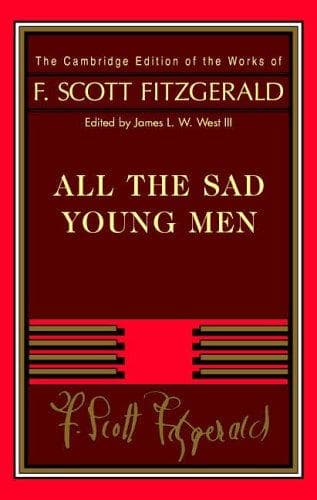
All the Sad Young MenFitzgerald, F. Scott (Francis Scott)
General
All the Sad Young Men
Fitzgerald, F. Scott (Francis Scott)
American fiction -- 20th century; Short stories, American
His voice sank to a sort of mumble. He found himself saying
platitudinously that business was bad--saying it with revolting
facility.
Mr. Lacy made no argument. He rose without visible signs of
disappointment. Only his hands were still trembling and they worried
Mather. The old man was apologetic--he was sorry to have bothered him at
a time like this. Perhaps something would turn up. He had thought that
if Mr. Mather did happen to have a good deal extra--why, he might be the
person to go to because he was the son of an old friend.
As he left the office he had trouble opening the outer door. Miss Clancy
helped him. He went shabbily and unhappily down the corridor with his
faded eyes blinking and his mouth still faintly ajar.
Jim Mather stood by his desk, and put his hand over his face and
shivered suddenly as if he were cold. But the five-o'clock air outside
was hot as a tropic noon.
IV
The twilight was hotter still an hour later as he stood at the corner
waiting for his car. The trolley-ride to his house was twenty-five
minutes, and he bought a pink-jacketed newspaper to appetize his
listless mind. Life had seemed less happy, less glamourous of late.
Perhaps he had learned more of the world's ways--perhaps its glamour was
evaporating little by little with the hurried years.
Nothing like this afternoon, for instance, had ever happened to him
before. He could not dismiss the old man from his mind. He pictured him
plodding home in the weary heat--on foot, probably, to save
carfare--opening the door of a hot little flat, and confessing to his
daughter that the son of his friend had not been able to help him out.
All evening they would plan helplessly until they said good night to
each other--father and daughter, isolated by chance in this world--and
went to lie awake with a pathetic loneliness in their two beds.
Mather's street-car came along, and he found a seat near the front, next
to an old lady who looked at him grudgingly as she moved over. At the
next block a crowd of girls from the department-store district flowed up
the aisle, and Mather unfolded his paper. Of late he had not indulged
his habit of giving up his seat. Jaqueline was right--the average young
girl was able to stand as well as he was. Giving up his seat was silly,
a mere gesture. Nowadays not one woman in a dozen even bothered to thank
him.
It was stifling hot in the car, and he wiped the heavy damp from his
forehead. The aisle was thickly packed now, and a woman standing beside
his seat was thrown momentarily against his shoulder as the car turned a
corner. Mather took a long breath of the hot foul air, which
persistently refused to circulate, and tried to centre his mind on a
cartoon at the top of the sporting page.
"Move for'ard ina car, please!" The conductor's voice pierced the opaque
column of humanity with raucous irritation. "Plen'y of room for'ard!"
Public-domain text, read in full here on John Shaqi.
Reviews
Reviews
No reviews yet
Be the first to share your thoughts on this work.
Elsewhere in the archive
Join the Discussion
Join the discussion
Sign in to leave a comment or review.
Sign InorCreate an account