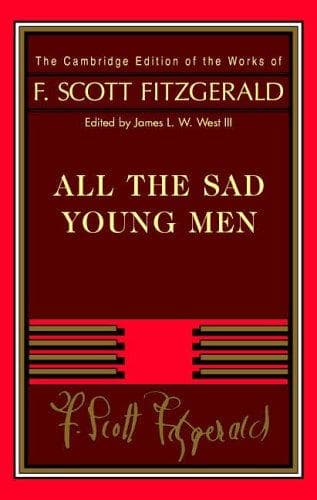
All the Sad Young MenFitzgerald, F. Scott (Francis Scott)
General
All the Sad Young Men
Fitzgerald, F. Scott (Francis Scott)
American fiction -- 20th century; Short stories, American
This "cynicism," or rather his realization that naturally fast girls
were not worth sparing, led to his affair with Dolly Karger. It wasn't
his only affair in those years, but it came nearest to touching him
deeply, and it had a profound effect upon his attitude toward life.
Dolly was the daughter of a notorious "publicist" who had married into
society. She herself grew up into the Junior League, came out at the
Plaza, and went to the Assembly; and only a few old families like the
Hunters could question whether or not she "belonged," for her picture
was often in the papers, and she had more enviable attention than many
girls who undoubtedly did. She was dark-haired, with carmine
lips and a high, lovely color, which she concealed under pinkish-gray
powder all through the first year out, because high color was
unfashionable--Victorian-pale was the thing to be. She wore black,
severe suits and stood with her hands in her pockets leaning a little
forward, with a humorous restraint on her face. She danced
exquisitely--better than anything she liked to dance--better than
anything except making love. Since she was ten she had always been in
love, and, usually, with some boy who didn't respond to her. Those who
did--and there were many--bored her after a brief encounter, but for
her failures she reserved the warmest spot in her heart. When she met
them she would always try once more--sometimes she succeeded, more often
she failed.
It never occurred to this gypsy of the unattainable that there was a
certain resemblance in those who refused to love her--they shared a hard
intuition that saw through to her weakness, not a weakness of emotion
but a weakness of rudder. Anson perceived this when he first met her,
less than a month after Paula's marriage. He was drinking rather
heavily, and he pretended for a week that he was falling in love with
her. Then he dropped her abruptly and forgot--immediately he took up the
commanding position in her heart.
Like so many girls of that day Dolly was slackly and indiscreetly wild.
The unconventionality of a slightly older generation had been simply one
facet of a post-war movement to discredit obsolete manners--Dolly's was
both older and shabbier, and she saw in Anson the two extremes which the
emotionally shiftless woman seeks, an abandon to indulgence alternating
with a protective strength. In his character she felt both the sybarite
and the solid rock, and these two satisfied every need of her nature.
She felt that it was going to be difficult, but she mistook the
reason--she thought that Anson and his family expected a more
spectacular marriage, but she guessed immediately that her advantage lay
in his tendency to drink.
Public-domain text, read in full here on John Shaqi.
Reviews
Reviews
No reviews yet
Be the first to share your thoughts on this work.
Join the Discussion
Join the discussion
Sign in to leave a comment or review.
Sign InorCreate an account