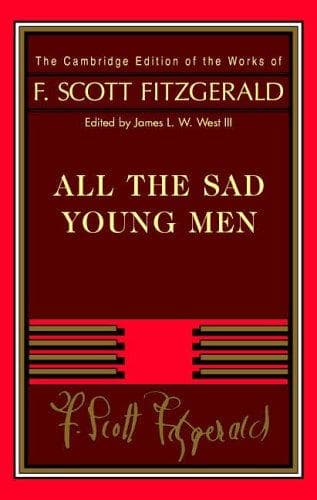
All the Sad Young MenFitzgerald, F. Scott (Francis Scott)
General
All the Sad Young Men
Fitzgerald, F. Scott (Francis Scott)
American fiction -- 20th century; Short stories, American
There was something repetitive about it--why, Paula and Dolly had
belonged to different generations. He had a foretaste of the sensation
of a man of forty who hears that the daughter of an old flame has
married. He wired congratulations and, as was not the case with Paula,
they were sincere--he had never really hoped that Paula would be happy.
When he returned to New York, he was made a partner in the firm, and, as
his responsibilities increased, he had less time on his hands. The
refusal of a life-insurance company to issue him a policy made such an
impression on him that he stopped drinking for a year, and claimed that
he felt better physically, though I think he missed the convivial
recounting of those Celliniesque adventures which, in his early
twenties, had played such a part of his life. But he never abandoned the
Yale Club. He was a figure there, a personality, and the tendency of his
class, who were now seven years out of college, to drift away to more
sober haunts was checked by his presence.
His day was never too full nor his mind too weary to give any sort of
aid to any one who asked it. What had been done at first through pride
and superiority had become a habit and a passion. And there was always
something--a younger brother in trouble at New Haven, a quarrel to be
patched up between a friend and his wife, a position to be found for
this man, an investment for that. But his specialty was the solving of
problems for young married people. Young married people fascinated him
and their apartments were almost sacred to him--he knew the story of
their love-affair, advised them where to live and how, and remembered
their babies' names. Toward young wives his attitude was circumspect: he
never abused the trust which their husbands--strangely enough in view of
his unconcealed irregularities--invariably reposed in him.
He came to take a vicarious pleasure in happy marriages, and to be
inspired to an almost equally pleasant melancholy by those that went
astray. Not a season passed that he did not witness the collapse of an
affair that perhaps he himself had fathered. When Paula was divorced and
almost immediately remarried to another Bostonian, he talked about her
to me all one afternoon. He would never love any one as he had loved
Paula, but he insisted that he no longer cared.
"I'll never marry," he came to say; "I've seen too much of it, and I
know a happy marriage is a very rare thing. Besides, I'm too old."
Public-domain text, read in full here on John Shaqi.
Reviews
Reviews
No reviews yet
Be the first to share your thoughts on this work.
Join the Discussion
Join the discussion
Sign in to leave a comment or review.
Sign InorCreate an account