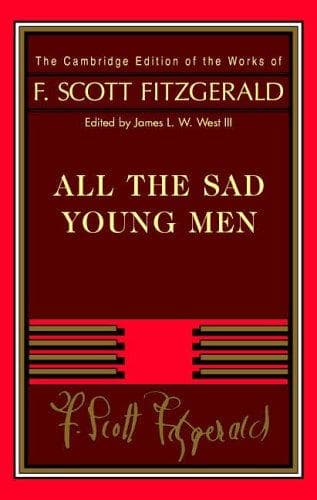
All the Sad Young MenFitzgerald, F. Scott (Francis Scott)
General
All the Sad Young Men
Fitzgerald, F. Scott (Francis Scott)
American fiction -- 20th century; Short stories, American
But he did believe in marriage. Like all men who spring from a happy and
successful marriage, he believed in it passionately--nothing he had seen
would change his belief, his cynicism dissolved upon it like air. But he
did really believe he was too old. At twenty-eight he began to accept
with equanimity the prospect of marrying without romantic love; he
resolutely chose a New York girl of his own class, pretty, intelligent,
congenial, above reproach--and set about falling in love with her. The
things he had said to Paula with sincerity, to other girls with grace,
he could no longer say at all without smiling, or with the force
necessary to convince.
"When I'm forty," he told his friends, "I'll be ripe. I'll fall for some
chorus girl like the rest."
Nevertheless, he persisted in his attempt. His mother wanted to see him
married, and he could now well afford it--he had a seat on the Stock
Exchange, and his earned income came to twenty-five thousand a year. The
idea was agreeable: when his friends--he spent most of his time with the
set he and Dolly had evolved--closed themselves in behind domestic doors
at night, he no longer rejoiced in his freedom. He even wondered if he
should have married Dolly. Not even Paula had loved him more, and he was
learning the rarity, in a single life, of encountering true emotion.
Just as this mood began to creep over him a disquieting story reached
his ear. His aunt Edna, a woman just this side of forty, was carrying on
an open intrigue with a dissolute, hard-drinking young man named Cary
Sloane. Every one knew of it except Anson's Uncle Robert, who for
fifteen years had talked long in clubs and taken his wife for granted.
Anson heard the story again and again with increasing annoyance.
Something of his old feeling for his uncle came back to him, a feeling
that was more than personal, a reversion toward that family solidarity
on which he had based his pride. His intuition singled out the essential
point of the affair, which was that his uncle shouldn't be hurt. It was
his first experiment in unsolicited meddling, but with his knowledge of
Edna's character he felt that he could handle the matter better than a
district judge or his uncle.
His uncle was in Hot Springs. Anson traced down the sources of the
scandal so that there should be no possibility of mistake and then he
called Edna and asked her to lunch with him at the Plaza next day.
Something in his tone must have frightened her, for she was reluctant,
but he insisted, putting off the date until she had no excuse for
refusing.
She met him at the appointed time in the Plaza lobby, a lovely, faded,
gray-eyed blonde in a coat of Russian sable. Five great rings, cold with
diamonds and emeralds, sparkled on her slender hands. It occurred to
Anson that it was his father's intelligence and not his uncle's that had
earned the fur and the stones, the rich brilliance that buoyed up her
passing beauty.
Public-domain text, read in full here on John Shaqi.
Reviews
Reviews
No reviews yet
Be the first to share your thoughts on this work.
Join the Discussion
Join the discussion
Sign in to leave a comment or review.
Sign InorCreate an account