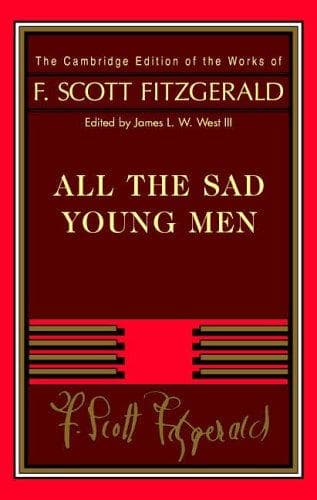
All the Sad Young MenFitzgerald, F. Scott (Francis Scott)
General
All the Sad Young Men
Fitzgerald, F. Scott (Francis Scott)
American fiction -- 20th century; Short stories, American
At two o'clock in a small night-club on 53d Street, Edna's nerves
suddenly collapsed, and she cried to go home. Sloane had been drinking
heavily all evening, and he was faintly maudlin, leaning on the table
and weeping a little with his face in his hands. Quickly Anson gave them
his terms. Sloane was to leave town for six months, and he must be gone
within forty-eight hours. When he returned there was to be no resumption
of the affair, but at the end of a year Edna might, if she wished, tell
Robert Hunter that she wanted a divorce and go about it in the usual
way.
He paused, gaining confidence from their faces for his final word.
"Or there's another thing you can do," he said slowly, "if Edna wants to
leave her children, there's nothing I can do to prevent your running off
together."
"I want to go home!" cried Edna again. "Oh, haven't you done enough to
us for one day?"
Outside it was dark, save for a blurred glow from Sixth Avenue down the
street. In that light those two who had been lovers looked for the last
time into each other's tragic faces, realizing that between them there
was not enough youth and strength to avert their eternal parting. Sloane
walked suddenly off down the street and Anson tapped a dozing
taxi-driver on the arm.
It was almost four; there was a patient flow of cleaning water along the
ghostly pavement of Fifth Avenue, and the shadows of two night women
flitted over the dark façade of St. Thomas's church. Then the desolate
shrubbery of Central Park where Anson had often played as a child, and
the mounting numbers, significant as names, of the marching streets.
This was his city, he thought, where his name had flourished through
five generations. No change could alter the permanence of its place
here, for change itself was the essential substratum by which he and
those of his name identified themselves with the spirit of New York.
Resourcefulness and a powerful will--for his threats in weaker hands
would have been less than nothing--had beaten the gathering dust from
his uncle's name, from the name of his family, from even this shivering
figure that sat beside him in the car.
Cary Sloane's body was found next morning on the lower shelf of a pillar
of Queensboro Bridge. In the darkness and in his excitement he had
thought that it was the water flowing black beneath him, but in less
than a second it made no possible difference--unless he had planned to
think one last thought of Edna, and call out her name as he struggled
feebly in the water.
VII
Anson never blamed himself for his part in this affair--the situation
which brought it about had not been of his making. But the just suffer
with the unjust, and he found that his oldest and somehow his most
precious friendship was over. He never knew what distorted story Edna
told, but he was welcome in his uncle's house no longer.
Public-domain text, read in full here on John Shaqi.
Reviews
Reviews
No reviews yet
Be the first to share your thoughts on this work.
Join the Discussion
Join the discussion
Sign in to leave a comment or review.
Sign InorCreate an account