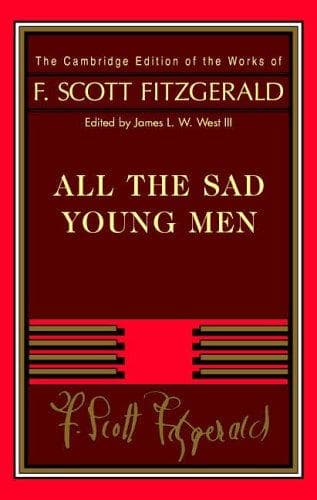
All the Sad Young MenFitzgerald, F. Scott (Francis Scott)
General
All the Sad Young Men
Fitzgerald, F. Scott (Francis Scott)
American fiction -- 20th century; Short stories, American
Just before Christmas Mrs. Hunter retired to a select Episcopal heaven,
and Anson became the responsible head of his family. An unmarried aunt
who had lived with them for years ran the house, and attempted with
helpless inefficiency to chaperone the younger girls. All the children
were less self-reliant than Anson, more conventional both in their
virtues and in their shortcomings. Mrs. Hunter's death had postponed the
début of one daughter and the wedding of another. Also it had taken
something deeply material from all of them, for with her passing the
quiet, expensive superiority of the Hunters came to an end.
For one thing, the estate, considerably diminished by two inheritance
taxes and soon to be divided among six children, was not a notable
fortune any more. Anson saw a tendency in his youngest sisters to speak
rather respectfully of families that hadn't "existed" twenty years ago.
His own feeling of precedence was not echoed in them--sometimes they
were conventionally snobbish, that was all. For another thing, this was
the last summer they would spend on the Connecticut estate; the clamor
against it was too loud: "Who wants to waste the best months of the year
shut up in that dead old town?" Reluctantly he yielded--the house would
go into the market in the fall, and next summer they would rent a
smaller place in Westchester County. It was a step down from the
expensive simplicity of his father's idea, and, while he sympathized
with the revolt, it also annoyed him; during his mother's lifetime he
had gone up there at least every other week-end--even in the gayest
summers.
Yet he himself was part of this change, and his strong instinct for life
had turned him in his twenties from the hollow obsequies of that
abortive leisure class. He did not see this clearly--he still felt that
there was a norm, a standard of society. But there was no norm, it was
doubtful if there had ever been a true norm in New York. The few who
still paid and fought to enter a particular set succeeded only to find
that as a society it scarcely functioned--or, what was more alarming,
that the Bohemia from which they fled sat above them at table.
At twenty-nine Anson's chief concern was his own growing loneliness. He
was sure now that he would never marry. The number of weddings at which
he had officiated as best man or usher was past all counting--there was
a drawer at home that bulged with the official neckties of this or that
wedding-party, neckties standing for romances that had not endured a
year, for couples who had passed completely from his life. Scarf-pins,
gold pencils, cuff-buttons, presents from a generation of grooms had
passed through his jewel-box and been lost--and with every ceremony he
was less and less able to imagine himself in the groom's place. Under
his hearty good-will toward all those marriages there was despair about
his own.
Public-domain text, read in full here on John Shaqi.
Reviews
Reviews
No reviews yet
Be the first to share your thoughts on this work.
Join the Discussion
Join the discussion
Sign in to leave a comment or review.
Sign InorCreate an account