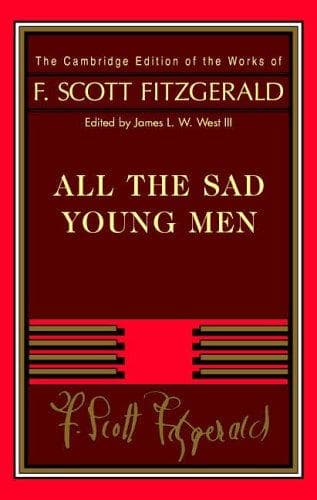
All the Sad Young MenFitzgerald, F. Scott (Francis Scott)
General
All the Sad Young Men
Fitzgerald, F. Scott (Francis Scott)
American fiction -- 20th century; Short stories, American
"Mr. Cahill's gone to New Haven."
"Oh ... that so?"
"Gone to the ball game. Lot of men gone up."
Anson looked once again into the lobby, considered for a moment, and
then walked out and over to Fifth Avenue. From the broad window of one
of his clubs--one that he had scarcely visited in five years--a gray man
with watery eyes stared down at him. Anson looked quickly away--that
figure sitting in vacant resignation, in supercilious solitude,
depressed him. He stopped and, retracing his steps, started over 47th
Street toward Teak Warden's apartment. Teak and his wife had once been
his most familiar friends--it was a household where he and Dolly Karger
had been used to go in the days of their affair. But Teak had taken to
drink, and his wife had remarked publicly that Anson was a bad influence
on him. The remark reached Anson in an exaggerated form--when it was
finally cleared up, the delicate spell of intimacy was broken, never to
be renewed.
"Is Mr. Warden at home?" he inquired.
"They've gone to the country."
The fact unexpectedly cut at him. They were gone to the country and he
hadn't known. Two years before he would have known the date, the hour,
come up at the last moment for a final drink, and planned his first
visit to them. Now they had gone without a word.
Anson looked at his watch and considered a week-end with his family, but
the only train was a local that would jolt through the aggressive heat
for three hours. And to-morrow in the country, and Sunday--he was in no
mood for porch-bridge with polite undergraduates, and dancing after
dinner at a rural road-house, a diminutive of gaiety which his father
had estimated too well.
"Oh, no," he said to himself.... "No."
He was a dignified, impressive young man, rather stout now, but
otherwise unmarked by dissipation. He could have been cast for a pillar
of something--at times you were sure it was not society, at others
nothing else--for the law, for the church. He stood for a few minutes
motionless on the sidewalk in front of a 47th Street apartment-house;
for almost the first time in his life he had nothing whatever to do.
Then he began to walk briskly up Fifth Avenue, as if he had just been
reminded of an important engagement there. The necessity of
dissimulation is one of the few characteristics that we share with dogs,
and I think of Anson on that day as some well-bred specimen who had been
disappointed at a familiar back door. He was going to see Nick, once a
fashionable bartender in demand at all private dances, and now employed
in cooling non-alcoholic champagne among the labyrinthine cellars of the
Plaza Hotel.
"Nick," he said, "what's happened to everything?"
"Dead," Nick said.
"Make me a whiskey sour." Anson handed a pint bottle over the counter.
"Nick, the girls are different; I had a little girl in Brooklyn and she
got married last week without letting me know."
"That a fact? Ha-ha-ha," responded Nick diplomatically. "Slipped it over
on you."
Public-domain text, read in full here on John Shaqi.
Reviews
Reviews
No reviews yet
Be the first to share your thoughts on this work.
Join the Discussion
Join the discussion
Sign in to leave a comment or review.
Sign InorCreate an account