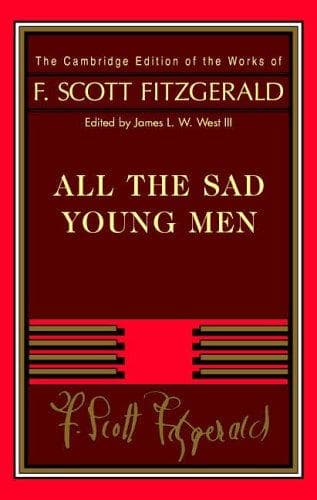
All the Sad Young MenFitzgerald, F. Scott (Francis Scott)
General
All the Sad Young Men
Fitzgerald, F. Scott (Francis Scott)
American fiction -- 20th century; Short stories, American
And as he neared thirty he became not a little depressed at the inroads
that marriage, especially lately, had made upon his friendships. Groups
of people had a disconcerting tendency to dissolve and disappear. The
men from his own college--and it was upon them he had expended the most
time and affection--were the most elusive of all. Most of them were
drawn deep into domesticity, two were dead, one lived abroad, one was in
Hollywood writing continuities for pictures that Anson went faithfully
to see.
Most of them, however, were permanent commuters with an intricate family
life centring around some suburban country club, and it was from these
that he felt his estrangement most keenly.
In the early days of their married life they had all needed him; he gave
them advice about their slim finances, he exorcised their doubts about
the advisability of bringing a baby into two rooms and a bath,
especially he stood for the great world outside. But now their financial
troubles were in the past and the fearfully expected child had evolved
into an absorbing family. They were always glad to see old Anson, but
they dressed up for him and tried to impress him with their present
importance, and kept their troubles to themselves. They needed him no
longer.
A few weeks before his thirtieth birthday the last of his early and
intimate friends was married. Anson acted in his usual rôle of best
man, gave his usual silver tea-service, and went down to the usual
_Homeric_ to say good-by. It was a hot Friday afternoon in May, and as
he walked from the pier he realized that Saturday closing had begun and
he was free until Monday morning.
"Go where?" he asked himself.
The Yale Club, of course; bridge until dinner, then four or five raw
cocktails in somebody's room and a pleasant confused evening. He
regretted that this afternoon's groom wouldn't be along--they had always
been able to cram so much into such nights: they knew how to attach
women and how to get rid of them, how much consideration any girl
deserved from their intelligent hedonism. A party was an adjusted
thing--you took certain girls to certain places and spent just so much
on their amusement; you drank a little, not much, more than you ought to
drink, and at a certain time in the morning you stood up and said you
were going home. You avoided college boys, sponges, future engagements,
fights, sentiment, and indiscretions. That was the way it was done. All
the rest was dissipation.
In the morning you were never violently sorry--you made no resolutions,
but if you had overdone it and your heart was slightly out of order, you
went on the wagon for a few days without saying anything about it, and
waited until an accumulation of nervous boredom projected you into
another party.
The lobby of the Yale Club was unpopulated. In the bar three very young
alumni looked up at him, momentarily and without curiosity.
"Hello there, Oscar," he said to the bartender. "Mr. Cahill been around
this afternoon?"
Public-domain text, read in full here on John Shaqi.
Reviews
Reviews
No reviews yet
Be the first to share your thoughts on this work.
Join the Discussion
Join the discussion
Sign in to leave a comment or review.
Sign InorCreate an account