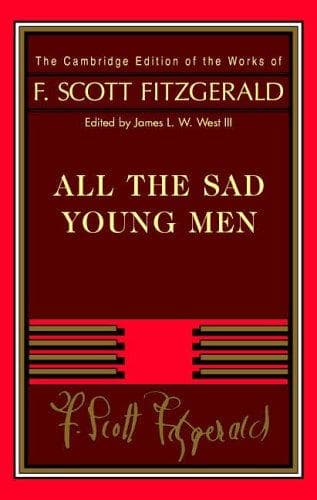
All the Sad Young MenFitzgerald, F. Scott (Francis Scott)
General
All the Sad Young Men
Fitzgerald, F. Scott (Francis Scott)
American fiction -- 20th century; Short stories, American
The familiar voice at his elbow startled him. Judy Jones had left a man
and crossed the room to him--Judy Jones, a slender enamelled doll in
cloth of gold: gold in a band at her head, gold in two slipper points at
her dress's hem. The fragile glow of her face seemed to blossom as she
smiled at him. A breeze of warmth and light blew through the room. His
hands in the pockets of his dinner-jacket tightened spasmodically. He
was filled with a sudden excitement.
"When did you get back?" he asked casually.
"Come here and I'll tell you about it."
She turned and he followed her. She had been away--he could have wept at
the wonder of her return. She had passed through enchanted streets,
doing things that were like provocative music. All mysterious
happenings, all fresh and quickening hopes, had gone away with her, come
back with her now.
She turned in the doorway.
"Have you a car here? If you haven't, I have."
"I have a coupé."
In then, with a rustle of golden cloth. He slammed the door. Into so many
cars she had stepped--like this--like that--her back against the
leather, so--her elbow resting on the door--waiting. She would have been
soiled long since had there been anything to soil her--except
herself--but this was her own self outpouring.
With an effort he forced himself to start the car and back into the
street. This was nothing, he must remember. She had done this before,
and he had put her behind him, as he would have crossed a bad account
from his books.
He drove slowly down-town and, affecting abstraction, traversed the
deserted streets of the business section, peopled here and there where a
movie was giving out its crowd or where consumptive or pugilistic youth
lounged in front of pool halls. The clink of glasses and the slap of
hands on the bars issued from saloons, cloisters of glazed glass and
dirty yellow light.
She was watching him closely and the silence was embarrassing; yet in
this crisis he could find no casual word with which to profane the hour.
At a convenient turning he began to zigzag back toward the University
Club.
"Have you missed me?" she asked suddenly.
"Everybody missed you."
He wondered if she knew of Irene Scheerer. She had been back only a
day--her absence had been almost contemporaneous with his engagement.
"What a remark!" Judy laughed sadly--without sadness. She looked at him
searchingly. He became absorbed in the dashboard.
"You're handsomer than you used to be," she said thoughtfully. "Dexter,
you have the most rememberable eyes."
He could have laughed at this, but he did not laugh. It was the sort of
thing that was said to sophomores. Yet it stabbed at him.
"I'm awfully tired of everything, darling." She called every one
darling, endowing the endearment with careless, individual comraderie.
"I wish you'd marry me."
Public-domain text, read in full here on John Shaqi.
Reviews
Reviews
No reviews yet
Be the first to share your thoughts on this work.
Join the Discussion
Join the discussion
Sign in to leave a comment or review.
Sign InorCreate an account