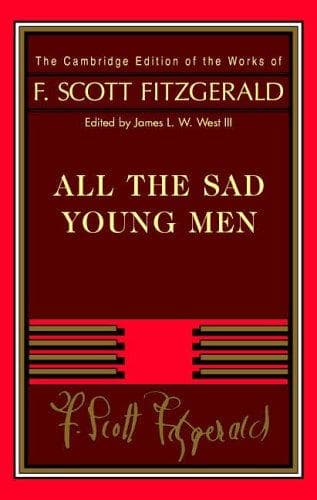
All the Sad Young MenFitzgerald, F. Scott (Francis Scott)
General
All the Sad Young Men
Fitzgerald, F. Scott (Francis Scott)
American fiction -- 20th century; Short stories, American
But an immediate marriage wasn't discussed--even the engagement was to
be secret until after the war. When she realized that only two days of
his leave remained, her dissatisfaction crystallized in the intention of
making him as unwilling to wait as she was. They were driving to the
country for dinner, and she determined to force the issue that night.
Now a cousin of Paula's was staying with them at the Ritz, a severe,
bitter girl who loved Paula but was somewhat jealous of her impressive
engagement, and as Paula was late in dressing, the cousin, who wasn't
going to the party, received Anson in the parlor of the suite.
Anson had met friends at five o'clock and drunk freely and indiscreetly
with them for an hour. He left the Yale Club at a proper time, and his
mother's chauffeur drove him to the Ritz, but his usual capacity was not
in evidence, and the impact of the steam-heated sitting-room made him
suddenly dizzy. He knew it, and he was both amused and sorry.
Paula's cousin was twenty-five, but she was exceptionally naïve; and at
first failed to realize what was up. She had never met Anson before, and
she was surprised when he mumbled strange information and nearly fell
off his chair, but until Paula appeared it didn't occur to her that what
she had taken for the odor of a dry-cleaned uniform was really whiskey.
But Paula understood as soon as she appeared; her only thought was to
get Anson away before her mother saw him, and at the look in her eyes
the cousin understood too.
When Paula and Anson descended to the limousine they found two men
inside, both asleep; they were the men with whom he had been drinking at
the Yale Club, and they were also going to the party. He had entirely
forgotten their presence in the car. On the way to Hempstead they awoke
and sang. Some of the songs were rough, and though Paula tried to
reconcile herself to the fact that Anson had few verbal inhibitions, her
lips tightened with shame and distaste.
Back at the hotel the cousin, confused and agitated, considered the
incident, and then walked into Mrs. Legendre's bedroom, saying: "Isn't
he funny?"
"Who is funny?"
"Why--Mr. Hunter. He seemed so funny."
Mrs. Legendre looked at her sharply.
"How is he funny?"
"Why, he said he was French. I didn't know he was French."
"That's absurd. You must have misunderstood." She smiled: "It was a
joke."
The cousin shook her head stubbornly.
"No. He said he was brought up in France. He said he couldn't speak any
English, and that's why he couldn't talk to me. And he couldn't!"
Mrs. Legendre looked away with impatience just as the cousin added
thoughtfully, "Perhaps it was because he was so drunk," and walked out
of the room.
This curious report was true. Anson, finding his voice thick and
uncontrollable, had taken the unusual refuge of announcing that he spoke
no English. Years afterward he used to tell that part of the story; and
he invariably communicated the uproarious laughter which the memory
aroused in him.
Public-domain text, read in full here on John Shaqi.
Reviews
Reviews
No reviews yet
Be the first to share your thoughts on this work.
Join the Discussion
Join the discussion
Sign in to leave a comment or review.
Sign InorCreate an account