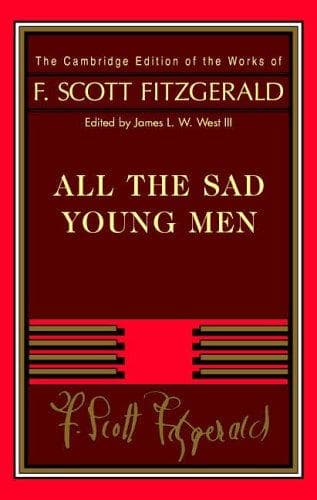
All the Sad Young MenFitzgerald, F. Scott (Francis Scott)
General
All the Sad Young Men
Fitzgerald, F. Scott (Francis Scott)
American fiction -- 20th century; Short stories, American
Nevertheless, they fell in love--and on her terms. He no longer joined
the twilight gathering at the De Sota bar, and whenever they were seen
together they were engaged in a long, serious dialogue, which must have
gone on several weeks. Long afterward he told me that it was not about
anything in particular but was composed on both sides of immature and
even meaningless statements--the emotional content that gradually came
to fill it grew up not out of the words but out of its enormous
seriousness. It was a sort of hypnosis. Often it was interrupted, giving
way to that emasculated humor we call fun; when they were alone it was
resumed again, solemn, low-keyed, and pitched so as to give each other a
sense of unity in feeling and thought. They came to resent any
interruptions of it, to be unresponsive to facetiousness about life,
even to the mild cynicism of their contemporaries. They were only happy
when the dialogue was going on, and its seriousness bathed them like the
amber glow of an open fire. Toward the end there came an interruption
they did not resent--it began to be interrupted by passion.
Oddly enough, Anson was as engrossed in the dialogue as she was and as
profoundly affected by it, yet at the same time aware that on his side
much was insincere, and on hers much was merely simple. At first, too,
he despised her emotional simplicity as well, but with his love her
nature deepened and blossomed, and he could despise it no longer. He
felt that if he could enter into Paula's warm safe life he would be
happy. The long preparation of the dialogue removed any constraint--he
taught her some of what he had learned from more adventurous women, and
she responded with a rapt holy intensity. One evening after a dance they
agreed to marry, and he wrote a long letter about her to his mother. The
next day Paula told him that she was rich, that she had a personal
fortune of nearly a million dollars.
III
It was exactly as if they could say "Neither of us has anything: we
shall be poor together"--just as delightful that they should be rich
instead. It gave them the same communion of adventure. Yet when Anson
got leave in April, and Paula and her mother accompanied him North, she
was impressed with the standing of his family in New York and with the
scale on which they lived. Alone with Anson for the first time in the
rooms where he had played as a boy, she was filled with a comfortable
emotion, as though she were pre-eminently safe and taken care of. The
pictures of Anson in a skull cap at his first school, of Anson on
horseback with the sweetheart of a mysterious forgotten summer, of Anson
in a gay group of ushers and bridesmaid at a wedding, made her jealous
of his life apart from her in the past, and so completely did his
authoritative person seem to sum up and typify these possessions of his
that she was inspired with the idea of being married immediately and
returning to Pensacola as his wife.
Public-domain text, read in full here on John Shaqi.
Reviews
Reviews
No reviews yet
Be the first to share your thoughts on this work.
Join the Discussion
Join the discussion
Sign in to leave a comment or review.
Sign InorCreate an account