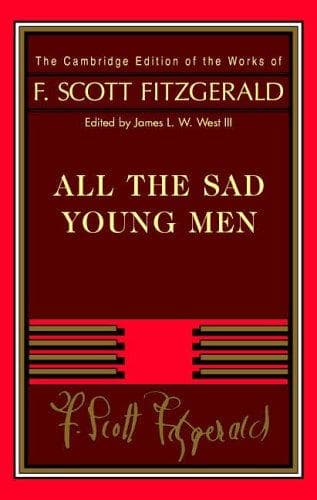
All the Sad Young MenFitzgerald, F. Scott (Francis Scott)
General
All the Sad Young Men
Fitzgerald, F. Scott (Francis Scott)
American fiction -- 20th century; Short stories, American
As the word left his mouth Rudolph knew it was the wrong answer, but the
faded indignant eyes facing him had signalled up the truth before the
boy's will could act. He realized, too, that he should never have come
down-stairs; some vague necessity for verisimilitude had made him want
to leave a wet glass as evidence by the sink; the honesty of his
imagination had betrayed him.
"Pour it out," commanded his father, "that water!"
Rudolph despairingly inverted the tumbler.
"What's the matter with you, anyways?" demanded Miller angrily.
"Nothing."
"Did you go to confession yesterday?"
"Yes."
"Then why were you going to drink water?"
"I don't know--I forgot."
"Maybe you care more about being a little bit thirsty than you do about
your religion."
"I forgot." Rudolph could feel the tears straining in his eyes.
"That's no answer."
"Well, I did."
"You better look out!" His father held to a high, persistent,
inquisitory note: "If you're so forgetful that you can't remember your
religion something better be done about it."
Rudolph filled a sharp pause with:
"I can remember it all right."
"First you begin to neglect your religion," cried his father, fanning
his own fierceness, "the next thing you'll begin to lie and steal, and
the _next_ thing is the _reform_ school!"
Not even this familiar threat could deepen the abyss that Rudolph saw
before him. He must either tell all now, offering his body for what he
knew would be a ferocious beating, or else tempt the thunderbolts by
receiving the Body and Blood of Christ with sacrilege upon his soul. And
of the two the former seemed more terrible--it was not so much the
beating he dreaded as the savage ferocity, outlet of the ineffectual
man, which would lie behind it.
"Put down that glass and go up-stairs and dress!" his father ordered,
"and when we get to church, before you go to communion, you better kneel
down and ask God to forgive you for your carelessness."
Some accidental emphasis in the phrasing of this command acted like a
catalytic agent on the confusion and terror of Rudolph's mind. A wild,
proud anger rose in him, and he dashed the tumbler passionately into the
sink.
His father uttered a strained, husky sound, and sprang for him. Rudolph
dodged to the side, tipped over a chair, and tried to get beyond the
kitchen table. He cried out sharply when a hand grasped his pajama
shoulder, then he felt the dull impact of a fist against the side of his
head, and glancing blows on the upper part of his body. As he slipped
here and there in his father's grasp, dragged or lifted when he clung
instinctively to an arm, aware of sharp smarts and strains, he made no
sound except that he laughed hysterically several times. Then in less
than a minute the blows abruptly ceased. After a lull during which
Rudolph was tightly held, and during which they both trembled violently
and uttered strange, truncated words, Carl Miller half dragged, half
threatened his son up-stairs.
"Put on your clothes!"
Public-domain text, read in full here on John Shaqi.
Reviews
Reviews
No reviews yet
Be the first to share your thoughts on this work.
Elsewhere in the archive
Join the Discussion
Join the discussion
Sign in to leave a comment or review.
Sign InorCreate an account