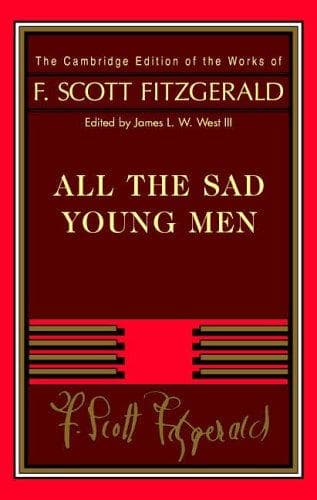
All the Sad Young MenFitzgerald, F. Scott (Francis Scott)
General
All the Sad Young Men
Fitzgerald, F. Scott (Francis Scott)
American fiction -- 20th century; Short stories, American
Rudolph was now both hysterical and cold. His head hurt him, and there
was a long, shallow scratch on his neck from his father's finger-nail,
and he sobbed and trembled as he dressed. He was aware of his mother
standing at the doorway in a wrapper, her wrinkled face compressing and
squeezing and opening out into new series of wrinkles which floated and
eddied from neck to brow. Despising her nervous ineffectuality and
avoiding her rudely when she tried to touch his neck with witch-hazel,
he made a hasty, choking toilet. Then he followed his father out of the
house and along the road toward the Catholic church.
IV
They walked without speaking except when Carl Miller acknowledged
automatically the existence of passers-by. Rudolph's uneven breathing
alone ruffled the hot Sunday silence.
His father stopped decisively at the door of the church.
"I've decided you'd better go to confession again. Go in and tell Father
Schwartz what you did and ask God's pardon."
"You lost your temper, too!" said Rudolph quickly.
Carl Miller took a step toward his son, who moved cautiously backward.
"All right, I'll go."
"Are you going to do what I say?" cried his father in a hoarse whisper.
"All right."
Rudolph walked into the church, and for the second time in two days
entered the confessional and knelt down. The slat went up almost at
once.
"I accuse myself of missing my morning prayers."
"Is that all?"
"That's all."
A maudlin exultation filled him. Not easily ever again would he be able
to put an abstraction before the necessities of his ease and pride. An
invisible line had been crossed, and he had become aware of his
isolation--aware that it applied not only to those moments when he was
Blatchford Sarnemington but that it applied to all his inner life.
Hitherto such phenomena as "crazy" ambitions and petty shames and fears
had been but private reservations, unacknowledged before the throne of
his official soul. Now he realized unconsciously that his private
reservations were himself--and all the rest a garnished front and a
conventional flag. The pressure of his environment had driven him into
the lonely secret road of adolescence.
He knelt in the pew beside his father. Mass began. Rudolph knelt
up--when he was alone he slumped his posterior back against the
seat--and tasted the consciousness of a sharp, subtle revenge. Beside
him his father prayed that God would forgive Rudolph, and asked also
that his own outbreak of temper would be pardoned. He glanced sidewise
at this son, and was relieved to see that the strained, wild look had
gone from his face and that he had ceased sobbing. The Grace of God,
inherent in the Sacrament, would do the rest, and perhaps after Mass
everything would be better. He was proud of Rudolph in his heart, and
beginning to be truly as well as formally sorry for what he had done.
Public-domain text, read in full here on John Shaqi.
Reviews
Reviews
No reviews yet
Be the first to share your thoughts on this work.
Elsewhere in the archive
Join the Discussion
Join the discussion
Sign in to leave a comment or review.
Sign InorCreate an account