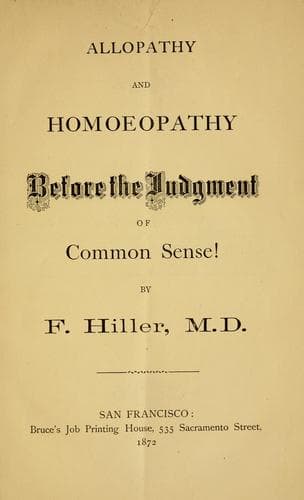
Allopathy and Homoeopathy Before the Judgment of Common Sense!Hiller, Frederick
History
Allopathy and Homoeopathy Before the Judgment of Common Sense!
Hiller, Frederick
Hahnemann, Samuel, 1755-1843; Homeopathy
Such sterling qualities, rooted in the boy's heart, and early budding
out in his life, made him beloved by all who came in contact with him.
Play-mates, school-fellows and instructors not only treated him with
kindness, but with ardent affection.
This school-boy life did not pass, however, without trials, the
greatest of which was the disinclination of his father for him to
continue his studies. It is a little strange that the good man, who
himself possessed a keen power of observation, did not once suspect
the future greatness of his child: but he was very poor, had several
other children to support, and doubtless feared that a thorough
classical and scientific education would give to his son aspirations
that would be doomed to bitter disappointment. His teacher, however,
pleaded on his behalf, offering to remit the usual school-fees, and
he was permitted to continue his studies until he was twenty years
of age. A proof of the poverty of his parents at this time, is
illustrated by the circumstance, that his father complained of the
great consumption of oil during young Hahnemann's preparation of his
lessons, and would not permit him to use the family lamp after the
other members of the household had retired: but Samuel, who was never
daunted by difficulties, or frustrated in a purpose, when he had
concluded that it was legitimate, manufactured a lamp out of a lump of
clay, and successfully coaxed his mother to supply him with oil.
At the close of his high school term, young Hahnemann wrote, as was
usual with those just finishing their course, a treatise. He had
for some time manifested a deep interest in natural science, and
particularly in the branches of chemistry and physiology. He wrote
his thesis in Latin, choosing as his subject, "The wisdom of God in
forming the Human Hand." This was for his age, a work of great merit,
and even his father seemed to have become proud of his abilities, and
gave his free consent for the studious boy to go to Leipzig that he
might attend the lectures at the University, and presented him with
all the money he possibly could spare, amounting to nearly fifteen
dollars in our currency. "This," says Hahnemann, "was the last money
I received from my father." He left his home for Leipzig on Easter,
1775.
Public-domain text, read in full here on John Shaqi.
Reviews
Reviews
No reviews yet
Be the first to share your thoughts on this work.
Join the Discussion
Join the discussion
Sign in to leave a comment or review.
Sign InorCreate an account