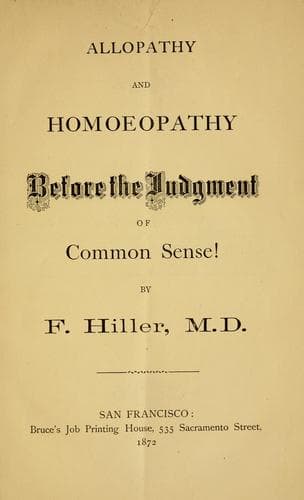
Allopathy and Homoeopathy Before the Judgment of Common Sense!Hiller, Frederick
History
Allopathy and Homoeopathy Before the Judgment of Common Sense!
Hiller, Frederick
Hahnemann, Samuel, 1755-1843; Homeopathy
In the picturesque town of Meissen, in the district of Cur Saxony,
lived an honest and worthy man, Christian Gottfried Hahnemann, an
intelligent, patriotic and highly esteemed, though unassuming
and unambitious member of that community, by trade a painter upon
porcelain, known under the name of Dresden-China.
On the 10th day of April, 1755, he was made happy by the birth of a
son, whom he named Samuel Christian Frederick. Amidst all the fond
hopes the parents cherished for their new-born babe, little did they
imagine to what a destiny the great Creator had appointed him. Of the
mother of this child not very much is known, save that she was modest,
industrious, intensely attached to her family, full of sympathy
with her children's aspirations, and ever-ready to aid them in their
schemes of pleasure or advancement. The infantile years of little
Hahnemann were spent amidst scenery so strikingly beautiful, as to
impress his young buoyant heart, even in those tender years, with an
admiration of Nature's handiwork, and so instill into him a love of
the works of God, which ever increased as he grew older. He was not
sent to school very young, not until he was eight years old; this will
perhaps partly account for the fact that when he did go, he manifested
an ardent thirst for knowledge, which was never slacked during his
long life-time. But he did not spend his first eight years of life
entirely in play. Those health-securing, physical-exhilarating and
developing exercises were occasionally relieved by lessons from his
father, and sometimes from his mother, in reading and writing, and by
frequent conversations of a religious and moral character.
These conversations laid deep the foundation of that undeviating
integrity, fixedness of purpose, unwavering conscientiousness and
unaffected reverence for the Divine Being, which ever characterized
this Medical Reformer in after life. The influence of this paternal
conversational instruction and moral training made him what he was,
as a school-boy, as a college-student, as an author, a chemist and a
physician. Untiring industry, conscientiousness, and a reliance upon
Divine blessing, will in any sphere in life secure success, and Samuel
Hahnemann was no exception to the general rule. In writing on this
subject, he says: "My father had the soundest ideas on what was to be
considered good and worthy in man, and had arrived at them by his own
independent thought. He sought to plant them in me, and impressed on
me more by actions than by words, the great lesson of life, to act and
to be, not merely to seem! When a good work was going forward, there,
often unobserved, he was sure to be helping, hand to heart; shall I
not do likewise? In the finest distinctions between the noble and the
base, he decided by his actions with a justness that did honor to
the nicety of his sense of right and wrong. In this, too, he was my
monitor."
Public-domain text, read in full here on John Shaqi.
Reviews
Reviews
No reviews yet
Be the first to share your thoughts on this work.
Join the Discussion
Join the discussion
Sign in to leave a comment or review.
Sign InorCreate an account