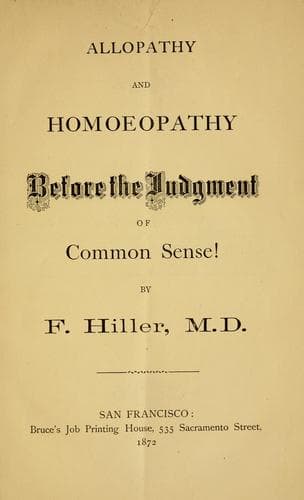
Allopathy and Homoeopathy Before the Judgment of Common Sense!Hiller, Frederick
History
Allopathy and Homoeopathy Before the Judgment of Common Sense!
Hiller, Frederick
Hahnemann, Samuel, 1755-1843; Homeopathy
He found but little opportunity to test his newly-discovered law of
cure while he remained in Leipzig, and poverty compelled him to labor
with his pen most indefatigably, as was evidenced by the large number
of essays and translations published at that time.
Providence, however, interfered in his behalf; the reigning Duke of
Saxe Gotha offered him the position of Physician to the Asylum for the
Insane in Georgenthal, in the Thuringen Forest. He entered upon his
duties in 1792. While at the head of this establishment, he succeeded
in affecting a cure which created some sensation, because the party
concerned was the Hanoverian Minister, Klockenbring, who was rendered
insane by a lampoon written by Kotzebue. He also introduced a mild and
humane treatment for the insane, removing the chains and tight-jacket,
heretofore in use.
In 1810, he published his greatest work, "The Organon," which ran
through five editions, and was translated into most all the living
languages. From 1810 to 1821, we find him again in Leipzig, publishing
his _Materia Medica_, and lecturing twice a week in the University, at
the same time attending to a multitude of patients.
In 1821, Hahnemann was induced by the reigning Duke of Anhalt-Coethen,
who was his warm friend and admirer, to change his place of residence,
and appointed him his Physician. He accepted the position. He
soon began to work as earnestly as before in proving medicines and
prescribing for his patients, who came from all parts of Europe.
On one occasion, during his residence in Coethen, he recieved a
visitor who had heard a great deal of Hahnemann and his garden, and
who had imagined the garden to be as large as its owner was great.
When he was ushered into the presence of the Prophet of Medicine and
found him seated at a table in a summer-house, only a few yards
from the dwelling, he exclaimed: "But where is the garden?" To which
Hahnemann replied, "This is the garden." "Surely," rejoined the
visitor, "Not this narrow patch of ground?" "True, it is very narrow
and very short, but observe its infinite height," said the Sage,
pointing upwards to the blue sky overhead.
The tenth of August, 1829, was a joyful day for the venerable old man,
being the fifteenth anniversary of his obtaining the degree of M. D.
Gratifying and memorable in more than one respect was this day for
him.
I refrain from giving you a full description of this impressive
celebration, lest I should be considered tedious, yet I cannot
thus pass over historical facts, without dwelling upon a few of the
principal features of this gratifying and memorable festivity.
Public-domain text, read in full here on John Shaqi.
Reviews
Reviews
No reviews yet
Be the first to share your thoughts on this work.
Join the Discussion
Join the discussion
Sign in to leave a comment or review.
Sign InorCreate an account