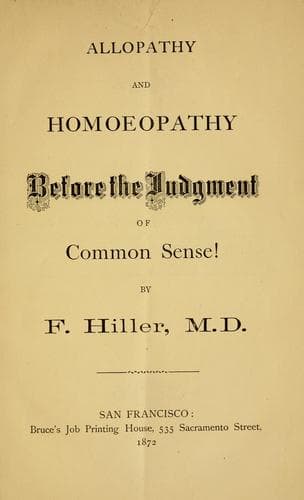
Allopathy and Homoeopathy Before the Judgment of Common Sense!Hiller, Frederick
History
Allopathy and Homoeopathy Before the Judgment of Common Sense!
Hiller, Frederick
Hahnemann, Samuel, 1755-1843; Homeopathy
The early morning found assembled a large number of the friends
of Hahnemann, his disciples; deputations from various cities; also
deputations from the Universities of Leipzig, Vienna and Erlangen,
which presented him with the Diploma of Honor. The King of Saxony, the
Duke of Saxe Gotha and many others had sent costly presents from far
and near. His dwelling having been appropriately prepared for the
celebration, and on a table, resembling an altar, adorned with flowers
and entwined with oak leaves, was placed a well executed bust of
Hahnemann.
After Hahnemann was introduced, his bust was crowned with laurels,
amid appropriate addresses and congratulations. With deep emotion, the
venerable old man in heartfelt and affecting words, gave thanks to the
Supreme Being that he had been permitted to make so great a discovery,
and was so favored with a long life, full of bodily and mental vigor.
A year after this important occurrence, the Asiatic Cholera came
marching from the East, for the first time. This aroused the medical
profession in general. Physicians were helpless, and none of them
had ever seen a case of this fearful disease. But Hahnemann, after
learning the symptoms of the disease, advised the mode of treatment
by which the mortality of that terrible scourge was threefold reduced,
and numerous testimonials were published, showing the immense success
of his mode of treatment. In 1831, he lost his partner in life, having
been married forty-nine years and a few months.
About four years after the death of his wife, a most interesting,
intelligent and estimable lady, applied to Hahnemann for advice for
lung and heart disease. It has been humorously stated that though the
lung disease was effectually cured, the trouble of the heart must have
assumed a chronic form, for the fascinating Parisienne seemed deeply
enamored with the great doctor. She was 35 years of age, the daughter
of Louis Jerome Cohier, formerly Minister of Justice and President and
Director of the French Republic, her name was Marie Melanie d'Herville
Cohier. This lady of position and wealth offered her hand to the
octogenarian, which he accepted, and after having divided his
considerable fortune among his children, upon which his young wife
insisted, he was induced by her to pass the rest of his life in Paris,
where he enjoyed a great reputation till his death, which took place
July 2nd, 1843. On the centenary of his birthday in 1855, a statute
was erected to his memory at Leipzig.
* * * * *
To complete the picture of this great man, I have to cite from a
letter written by Dr. Jahr in Paris on the fourth of July 1843, where
he says:
Public-domain text, read in full here on John Shaqi.
Reviews
Reviews
No reviews yet
Be the first to share your thoughts on this work.
Join the Discussion
Join the discussion
Sign in to leave a comment or review.
Sign InorCreate an account