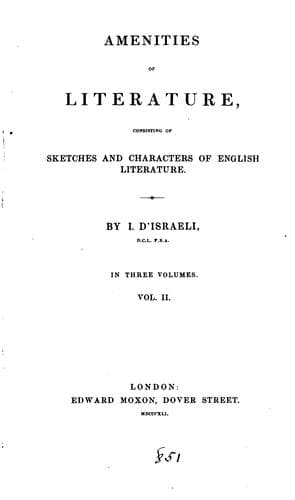
Amenities of Literature: Consisting of Sketches and Characters of English LiteratureDisraeli, Isaac
History
Amenities of Literature: Consisting of Sketches and Characters of English Literature
Disraeli, Isaac
Authors, English -- Biography; English literature -- History and criticism; Great Britain -- Intellectual life
But the picturesque language of our emotions, the creative diction of
poetry, appeared in the courtly style of Chaucer, who nobly designed to
render the national language refined and varied, while his great
contemporaries, the author of Piers Ploughman lingered in a rude
dialect, and Gower was still composing alternately in Latin and in
French.
The emancipation of the national language was subsequently confirmed by
another monarch. A curious anecdote in our literary history has recently
been disclosed of Henry V. To encourage the use of the vernacular
tongue, this monarch, in a letter missive to one of the city companies,
declared that "_the English tongue hath in modern days begun to be
honourably enlarged and adorned, and for the better understanding of the
people_ the common idiom should be exercised in writing:" this was at
once setting aside the Norman-French and the Latin for the daily
business of civil life. By this record it appears that many of the craft
of brewers, to whose company this letter was addressed, had "knowledge
of writing and reading in the English idiom, but Latin and French they
by no means understood." We further learn that now "the LORDS and the
COMMONS BEGAN _to have their proceedings noted down in the mother
tongue_;" and this example was therefore to be followed by the city
companies.[16]
At this advanced age of transition, so unsettled was the language of
ordinary affairs, that the same document bears evidence of three
different idioms. We find the petition of an Irish chieftain, a prisoner
in the Tower, written in the French language, while the endorsed royal
answer is in English, and the order of the council in Latin.[17] The
bulletins of Henry V. to the mayor and aldermen of London are written in
English, but endorsed in French.
As if they designed to hold out a model to their subjects and to
sanction the use of their native English, both this prince, and his
father, Henry IV., left their wills in the national language,[18] at a
time when the nobles employed Latin or French for such purposes.
Public-domain text, read in full here on John Shaqi.
Reviews
Reviews
No reviews yet
Be the first to share your thoughts on this work.
Elsewhere in the archive
Join the Discussion
Join the discussion
Sign in to leave a comment or review.
Sign InorCreate an account