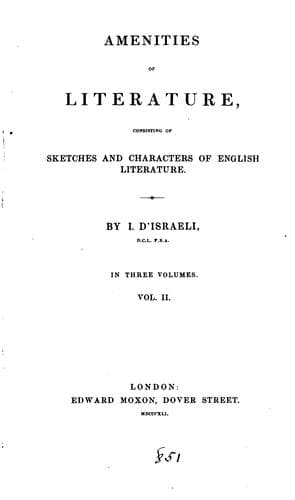
Amenities of Literature: Consisting of Sketches and Characters of English Literature — John Shaqi
Amenities of Literature: Consisting of Sketches and Characters of English LiteratureDisraeli, Isaac
History
Amenities of Literature: Consisting of Sketches and Characters of English Literature
Disraeli, Isaac
Authors, English -- Biography; English literature -- History and criticism; Great Britain -- Intellectual life
[2] The existence of these _giants_ was long historical, and their
real origin was in the fourth verse of the fifth chapter of Genesis,
which no commentator shall ever explain. AYLET SAMMES in his
"Britannia Antiqua Illustrata, or the Antiquities of Ancient Britain
derived from the Phoenicians," has particularly noticed "two teeth of
a certain giant, of such a huge bigness, that two hundred such teeth
as men now-a-days have might be cut out of them." Becanus and Camden
had however observed, that "_the bones of sea-fish_ had been taken
for _giants' bones_;--but can it be rationally supposed that men ever
entombed fishes?" triumphant in his arguments, exclaims Aylet Sammes.
The revelations of geology had not yet been surmised, even by those
who had discovered that giants were but sea-fish. So progressive is
all human knowledge.
[3] The miraculous event was perpetuated by the whole Teutonic
people, "while it was fresh in their memories," as our honest Saxon
asserts; hence to this day we in our Saxon _English_, and our
Teutonic kinsmen and neighbours in their idiom, describe a confusion
of idle talk by the term of _Babel_, now written from our harsh love
of supernumerary consonants _Babble_; and any such workmen of Babel
are still indicated as _Babblers_.--"A Restitution of Decayed
Intelligence," 138, 4to. Antwerp, 1605.
The erudite Menage offers a memorable evidence of the precarious
condition of etymology when it connects things which have no other
affinity than that which depends on _sounds_. See his "Dictionnaire
Etymologique, ou Origines de la Langue Françoise," ad verbum BABIL.
Not satisfied with the usual authorities deduced from _Babel_, this
verbal sage appeals to us English to demonstrate the natural
connexion between _Babbling and Childishness_; for thus he has
shrewdly opined "The English in this manner have _Babble_ and
_Baby_!"
After all the convulsion of lips at Babel, and confusion among the
etymologists, the word is Hebrew, which with a few more such are
found in many languages.
[4] Julia, the empress of Severus, once in raillery remonstrated with
a British female against this singular custom, which annulled every
connubial tie. The British woman, whose observation had evidently
been enlarged during her visit to Rome, retorted by her disdain of
the more polished corruption of the greater nation. "We British women
greatly differ from the Roman ladies, for we follow in public the men
whom we esteem the most worthy, while the Roman women yield
themselves secretly to the vilest of men."
Public-domain text, read in full here on John Shaqi.
Reviews
Reviews
No reviews yet
Be the first to share your thoughts on this work.
Join the Discussion
Join the discussion
Sign in to leave a comment or review.
Sign InorCreate an account