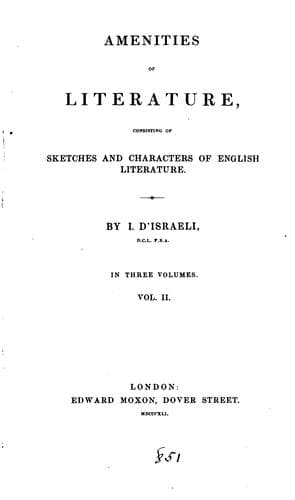
Amenities of Literature: Consisting of Sketches and Characters of English Literature — John Shaqi
Amenities of Literature: Consisting of Sketches and Characters of English LiteratureDisraeli, Isaac
History
Amenities of Literature: Consisting of Sketches and Characters of English Literature
Disraeli, Isaac
Authors, English -- Biography; English literature -- History and criticism; Great Britain -- Intellectual life
Such was the noble sentiment which broke forth from a lady of savage
education--it was, however, but a savage's view of social life. This
female Briton had not felt how much remained of life which she had
not taken into her view; when the attractions of her sex had ceased,
and the season of flowers had passed, she was left without her
connubial lord amid a progeny who had no father.
[5] This practice of savage races may have originated in a natural
circumstance. The naked body by this slight covering is protected
from the atmosphere, from insects, and other inconveniences to which
the unclothed are exposed. But though it may not have been considered
merely as personal finery, which seems sometimes to have been the
case, it became a refinement of barbarism when they painted their
bodies frightfully to look terrible to the enemy.
[6] See Mr. Tate's twelve questions about the Druids, with Mr.
Jones's answers; a learned Welsh scholar who commented on the ancient
laws of his nation.--Toland's "History of the Druids."
A later Welsh scholar affirms, "beyond all doubt there has been an
era when science diffused a light among the Cymry--in a very early
period of the world."--Owen's "Heroic Elegies of Llywarç Hen."
Preface, xxi.
This style is traditional and still kept up among Welsh and Irish
scholars, who seem familiar with an antiquity beyond record.
[7] Toland's "History of the Druids" in his Miscellaneous Works, ii.
163.
[8] "The Celtic Druids, or an Attempt to show that the Druids were
the Priests of Oriental Colonies, who emigrated from India." By
Godfrey Higgins, Esq. London, 1829.
This is a quarto volume abounding with recondite researches and many
fancies. It is more repulsive, by the absurd abuse of "the Christian
priests who destroyed their (the Druids') influence, and unnerved the
arms of their gallant followers." There are philosophical fanatics!
[9] Cæsar was a keen observer of the Britons. He characterizes the
Kentish men, _Ex his omnibus longè sunt humanissimi_,--"Of all this
people the Kentish are far the most humane." Cæsar describes the
British boats to have the keel and masts of the lightest wood, and
their bodies of wicker covered with leather; and the hero and sage
was taught a lesson by the barbarians, for Cæsar made use of these in
Spain to transport his soldiers,--a circumstance which Lucan has
recorded. In the size and magnitude of Britain, confiding to the
exaggerated accounts of the captives, he was mistaken; but he
acknowledges, that many things he heard of, he had not himself
observed.
[10] Toland's "Hist. of the Druids," 56.
Public-domain text, read in full here on John Shaqi.
Reviews
Reviews
No reviews yet
Be the first to share your thoughts on this work.
Join the Discussion
Join the discussion
Sign in to leave a comment or review.
Sign InorCreate an account