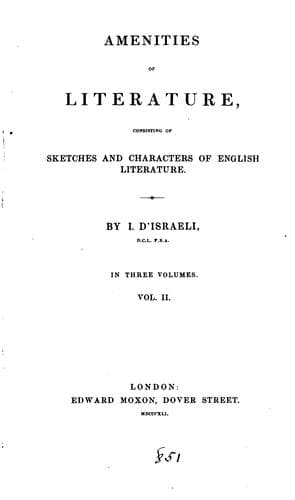
Amenities of Literature: Consisting of Sketches and Characters of English LiteratureDisraeli, Isaac
History
Amenities of Literature: Consisting of Sketches and Characters of English Literature
Disraeli, Isaac
Authors, English -- Biography; English literature -- History and criticism; Great Britain -- Intellectual life
One hardly expected to find philological acumen in the dry discussion
of law-Latin, but when the _three_ words, "_secundum formam
statuti_," require _seven_ in English, "according to the form of the
statute," one easily comprehends the heavy weight of the _stamp-duty_
for _writing English_. The Saxons, who made no use of particles of
speech, had more merit than we were aware of.
[15] By the Rev. JOHN LEWIS, 1731, fo., and republished by the Rev.
H. H. BABER, 1810, 4to.
The censure of Fabricius deserves our notice. After mention of
Wickliffe's version of the Bible, he adds, "Mirum est Anglos eam
(versionem) tam diu neglexisse quum vel linguæ causa ipsis in pretio
esse debeat."--"Bib. Lat.," v. 321.
It is provoking to be reminded of our neglected duties by a
foreigner. We might assuredly be curious to learn how the sublimity
and the colloquial and narrative parts of this vast treasure of our
ancient language were produced under the primitive pen of Wickliffe.
A fine copy of Wickliffe's Bible was in the library of Mr. Douce, and
I have heard, with great satisfaction, that it will probably be
edited by Sir Francis Madden.
[16] Herbert's "History of the City Companies."
[17] I derive this curious fact from Mr. Tyler's "History of Henry of
Monmouth," ii. 245.
[18] These wills are preserved in Mr. Nichols' "Collection of Royal
Wills."
[19] Le Comte de Neufchateau, "Essay on French Literature," prefixed
to the late edition of Pascal's works.
[20] "Edinburgh Review," Oct., 1839.
[21] See "Quarterly Rev.," lix. 34.--The critic is deeply imbued with
his delight of Saxon-English. "The first bursts in our literature
(probably the noblest are meant) are in almost pure Saxon." The
critic particularly appeals to Milton for two instances; yet surely
the Greekised, the Latinised, and even the Italianised Milton will
not serve to assert the pre-eminence of our venerable dialect. "A
country congregation" is its more certain test; where the language of
the people is the only language required. Cobbett's writings
throughout are Saxon-English. Coleridge considered Asgill and De Foe
the most idiomatic writers.
VICISSITUDES OF THE ENGLISH LANGUAGE.
The vicissitudes of the English language are more evident than its
origin. In the history of a language we are perpetually reminded, by the
remonstrances of the critics, of the corruptions of its purity, the
perils of innovation, and the obtrusion of neologisms, while we find
these same critics fastidiously rejecting what they deem the antiquated
and the obsolete; many causes are constantly operating these changes of
language. The style of one age ceases to be that of another; new
modifications of thought create new modes of expression; and as
knowledge enlarges its sphere, and society changes its manners, novel
objects imperiously demand adequate terms.
Public-domain text, read in full here on John Shaqi.
Reviews
Reviews
No reviews yet
Be the first to share your thoughts on this work.
Elsewhere in the archive