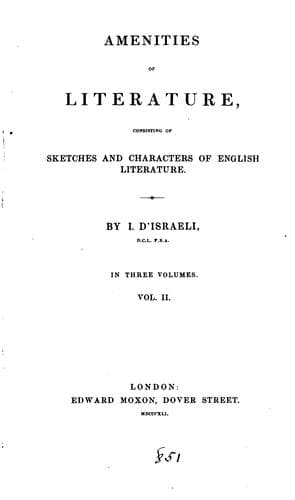
Amenities of Literature: Consisting of Sketches and Characters of English LiteratureDisraeli, Isaac
History
Amenities of Literature: Consisting of Sketches and Characters of English Literature
Disraeli, Isaac
Authors, English -- Biography; English literature -- History and criticism; Great Britain -- Intellectual life
Our language has been subjected to those dominant events in the history
of our country which have so powerfully influenced our genius and our
destiny; and, our insular position occasioning a general intercourse
with all the Continental nations, our national idiom has been mottled by
foreign neologisms.
For more than five centuries was the Saxon language the language of
England; the awful revolution of 1066 produced novelties of all kinds,
but none greater than the entire change in our Saxon language, which,
however, our Norman masters could never eradicate from among the people.
During three centuries most of our English writers composed in French.
When Greek was first studied in the reign of Henry the Seventh, it
planted many a hellenism in our English; the translation of the
Scriptures in that of Edward the Sixth, while it transmitted many
latinisms, at the same time revived the simplicity of the Saxon-English,
which seemed to bear a sort of evidence that a primitive language was
most suitable for primitive Christianity in contrast with the pompous
corruptions of Rome.
Under Elizabeth favourite phrases were insinuated into the dialect by
over-refined travellers, who spoke "minionlike," while the revolution
of the Netherlands incorporated among us many a rough but vigorous
inmate. In the days of James and Charles, the long residence of the
Spanish Gondomar at our court, and the romantic pilgrimage of love to
Madrid, and the political ties which bound the two nations, framed the
style of courtesy, as well as set the fashions.
The puritanic commonwealth under Cromwell sunk down the language to its
basest uses. Stripped to nakedness, the jargon of the market and the
shop hid itself under the gibberish of its cant. Writers then abounded
equally illiterate and fanatical. Perhaps we owe to these mean
scribblers the scorn and pride with which Milton constructed on the
Latin model of inversions and involutions of sentences his artificial
and learned prose, unlike the style of his contemporaries, and which was
never to be that of his successors; it was a machinery too costly for
its price, and too unwieldy for the handling of an ordinary workman.
Under the second Charles we see the nation and the language equally
gallicised, and so it remained to the days of Anne. Suppose for a moment
that when the first Georges were appointed to the English throne, the
Germany of that day had been the Germany of the present. What would have
been the result? Instead of two torpid Germans, destitute of every
sensibility to literature and art, we might have seen an accomplished
Duke of Weimar at St. James's, and a Wieland, a Schiller, and a Goethe
at our court; our authors had been impressed by the German genius, in
our emulation and delight. Such is the simple history of the English
language as it has been, or might have been, subjected to our national
events.
Public-domain text, read in full here on John Shaqi.
Reviews
Reviews
No reviews yet
Be the first to share your thoughts on this work.
Elsewhere in the archive
Join the Discussion
Join the discussion
Sign in to leave a comment or review.
Sign InorCreate an account