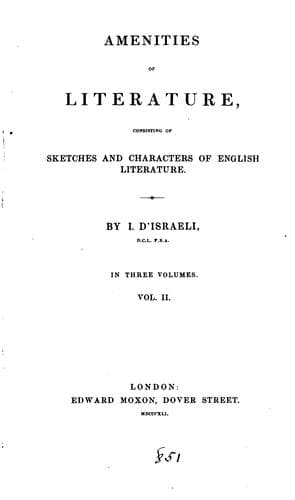
Amenities of Literature: Consisting of Sketches and Characters of English LiteratureDisraeli, Isaac
History
Amenities of Literature: Consisting of Sketches and Characters of English Literature
Disraeli, Isaac
Authors, English -- Biography; English literature -- History and criticism; Great Britain -- Intellectual life
In this history of the vicissitudes of the English language, we may
commence with our remote ancestors the Anglo-Saxons. When their studies
and their language received a literary character, they coveted great
pomposity in their style. They interlarded their staves with Latin
words; and, even in the reign of the Confessor, the French language was
fashionable. "The affectation of the Anglo-Saxon literati was evidently
tending to adulterate their language; and even if the Conquest had not
taken place, the purity of the English language would have been speedily
destroyed by the admixture of a foreign vocabulary."[3] Thus early were
we perilling our purity!
In 1387, John de Trevisa, translating the Latin Polychronicon of Higden,
tells us he avoids what he calls "the old and ancient English." A
century afterwards, Caxton, printing this translation of Trevisa, had to
re-write it, to change the "rude and old English, that is, to wit,
certain words which in these days be neither used nor understood." It
might have startled Master Caxton to have suspected that he might be to
us what Trevisa was to him, as it had equally amazed Trevisa, when he
discovered archaisms which had contracted the rust of time, to have
imagined that his fresher English were to be archaisms to his printer in
the succeeding century.
At the period at which our present vernacular literature opened on us,
Eliot, More, and Ascham maintained great simplicity of thought and
idiom; yet even at this period, about 1550, the language seemed in
imminent danger; it raised the tone of our primitive critics, and the
terrors of neologism took all frightful shapes to their eyes!
A refined critic of our language then was the learned Sir JOHN CHEKE,
who at this early period considered that the English language was
capable of preserving the utmost purity of style, and he was jealously
awake to its slightest violations. A friend of his, Sir THOMAS HOBY, a
courtly translator of the "Courtier of Castiglione," had solicited his
critical opinion. The learned Cheke, equally friendly and critical,
insinuated his abhorrence of "an unknown word," and apologises for his
corrections, lest he should be accounted "overstraight a deemer of
things, by marring his handywork." Hoby had evidently alarmed, by some
sprinklings of Italianisms--some capriccios of "new-fangled" words--the
chaste ear of our Anglican purist. I preserve this remarkable letter to
serve as a singular specimen of our English, unpolluted even by a
Latinism.[4]
Public-domain text, read in full here on John Shaqi.
Reviews
Reviews
No reviews yet
Be the first to share your thoughts on this work.
Elsewhere in the archive
Join the Discussion
Join the discussion
Sign in to leave a comment or review.
Sign InorCreate an account