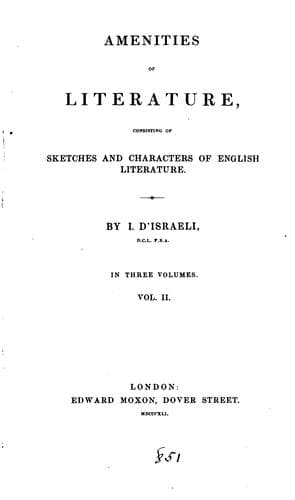
Amenities of Literature: Consisting of Sketches and Characters of English LiteratureDisraeli, Isaac
History
Amenities of Literature: Consisting of Sketches and Characters of English Literature
Disraeli, Isaac
Authors, English -- Biography; English literature -- History and criticism; Great Britain -- Intellectual life
A dialect is a variation in the pronunciation, and necessarily in the
orthography of words, or a peculiarity of phrase or idiom, usually
accompanied by a tone which seems to be as local as the word it utters.
It is a language rarely understood out of the sphere of the population
by whom it is appropriated. A language is fixed in a nation by a
flourishing metropolis of an extensive empire, a dialect may have
existed coeval with that predominant dialect which by accident has
become the standard or general language; and moreover, the contemned
dialect may occasionally preserve some remains or fragments of the
language which, apparently lost, but hence recovered, enable us rightly
to understand even the prevalent idiom.
All nations have had dialects. Greece had them, as France, and Italy
have them now. Homer could have included in a single verse four or five
dialects; but though the Doric and the Ionic were held the most
classical, none of them were barbarous, since their finest writers have
composed in these several dialects. Even some Italian poets and comic
writers have adopted a favourite dialect; but no classical English
author could have immortalised any one of our own.
Ancient Greece, as Mitford describes, "though a narrow country, was very
much divided by mountains and politics." And mountains and politics,
which impede the general intercourse of men, inevitably produce
dialects. Each isolated state with fear or pride affected its
independence, not only by its own customs, but by its accent or its
phrase. In France the standard language was long but a dialect. There
potent nobles, each holding a separate court and sovereignty in his own
province, offered many central points of attraction. The Counts of Foix,
of Provence and of Toulouse, and the Dukes of Guienne, of Normandy and
of Brétagne, were all munificent patrons of those who cultivated what
they termed "l'art du beau parler," each in their provincial idiom.
These were all subdivisions of the two rival dialects to which the
Romane language had given birth. But the river Loire ran between them;
and a great river has often been the boundary of a dialect: France was
thus long divided. On the south of the Loire their speech was called the
language of _Oc_, and on the north the language of _Oil_; names which
they derived from the different manner of the inhabitants pronouncing
the affirmative _Oui_. The language of the poetical Troubadours on the
south of the Loire had not the happier destiny of its rival, used by the
Trouvères on the north. It was this which became the standard language,
while the other remains a dialect. Here we have a remarkable incident in
the history of dialects in a great country; it was long doubtful which
was to become the national language; and it has happened, if we may
trust an enthusiast of Languedoc, that his idiom, expressing with more
vowelly softness and _naïveté_ the familiar emotions of love and
Public-domain text, read in full here on John Shaqi.
Reviews
Reviews
No reviews yet
Be the first to share your thoughts on this work.
Elsewhere in the archive
Join the Discussion
Join the discussion
Sign in to leave a comment or review.
Sign InorCreate an account