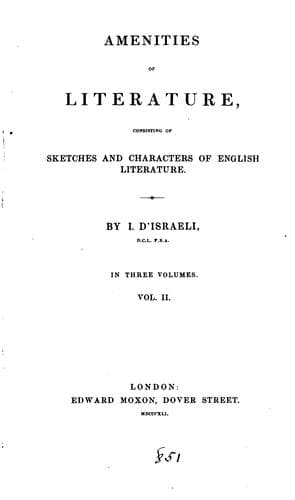
Amenities of Literature: Consisting of Sketches and Characters of English LiteratureDisraeli, Isaac
History
Amenities of Literature: Consisting of Sketches and Characters of English Literature
Disraeli, Isaac
Authors, English -- Biography; English literature -- History and criticism; Great Britain -- Intellectual life
friendship, and gaiety and _bonhomie_, gave way to a harsher idiom and a
sharp nasal accent; and all ended by the Parisian detecting the
provincials by their shibboleth, and calling them all alike Gascons, and
their taste for exaggeration and rhodomontade gasconades; while the
southerns, who hold that what is called the French language is only a
perversion of their own dialect, like our former John Bull, fling on the
Parisian the old Gaulish appellative of _Franchiman_.[1]
The dialects of England were produced by occurrences which have happened
to no other nation. Our insular site has laid us open to so many
masters, that it was long doubtful whether Britain would ever possess a
uniform language. The aboriginal Britons left some of their words
behind them in their flight, as the Romans had done in their
dominion,[2] and even the visiting Phoenician may have dropped some
words on our coasts. The Jutes, the Angles, and the Saxons brought in a
new language, and, arriving from separate localities, that language came
to us diversified by dialects; and the Danes, too, joined the northern
brotherhood of pirate-kings who planted themselves in our soil. The
gradual predominance of the West-Saxon over the petty kingdoms which
subdivided Britain first approached to the formation of a national
language. The West-Saxon was the land of Alfred, and the royal
cultivation of its dialect, supreme in purity as the realm stood in
power, rendered it the standard language which we now call Anglo-Saxon.
"Had the Heptarchy (Octarchy) continued," observed Bishop Percy, "our
English language would probably have been as much distinguished for its
dialects as the Greek, or at least as that of the several independent
states of Italy." In truth, we remained much in that condition while a
power hostile to the national character assumed the sovereignty. So
unsettled was the English language, that a writer at the close of the
fourteenth century tells us that different parts of the island
experienced a difficulty to understand one another. A diversity of
pronunciation, as well as a diversity in the language, was so prevalent,
that the Northern, the Southern, and the Middle-land men were
unintelligible when they met; the Middle-land understood the Northern
and the Southern better than the Northman and the Southman comprehended
one another; the English people seemed to form an assemblage of distinct
races. Even to this day, a scene almost similar might be exhibited.
Should a peasant of the Yorkshire dales, and one from the vales of
Taunton, and another from the hills of the Chiltern, meet together, they
would require an interpreter to become intelligible to each other; but
in this dilemma what county could produce the Englishman so versed in
provincial dialects as to assist his three honest countrymen?
Public-domain text, read in full here on John Shaqi.
Reviews
Reviews
No reviews yet
Be the first to share your thoughts on this work.
Elsewhere in the archive
Join the Discussion
Join the discussion
Sign in to leave a comment or review.
Sign InorCreate an account