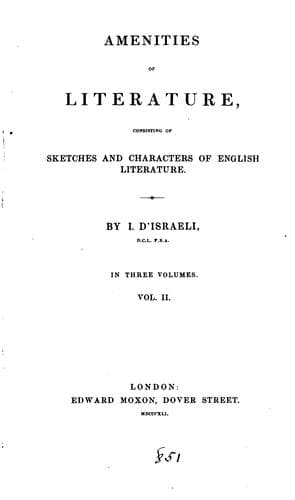
Amenities of Literature: Consisting of Sketches and Characters of English LiteratureDisraeli, Isaac
History
Amenities of Literature: Consisting of Sketches and Characters of English Literature
Disraeli, Isaac
Authors, English -- Biography; English literature -- History and criticism; Great Britain -- Intellectual life
If etymology often furnishes a genealogy of words through all their
authentic descents, so likewise a map of provincial idioms might be
constructed to indicate the localities of the dialects. There we might
observe how an expansive and lengthened river, or intervening fells and
mountains which separate two counties, can stop the course of a dialect,
so that the idiom current on one side, when it passes the borders
becomes intrusive, little regarded, and ere it reaches a third county
has expired in the passage. Thus the Parret, we are told, is the
boundary of the Somersetshire dialect; for words used cast of the Parret
are only known by synonyms on the west side. The same incident occurs in
Italy, where a single river runs through the level plain; there the
Piedmontese peasant from the western end meeting with a Venetian from
the eastern could hold but little colloquial intercourse together; a
Genoese would be absolutely unintelligible to both, for, according to
their proverb, "Language was the gift of God, but the Genoese dialect
was the invention of the devil." In those rank dialects left to run to
seed in their wild state, without any standard of literature, we hardly
recognise the national idiom; the Italian language sprung from one
common source--its maternal Latin; but this we might not suspect should
we decide solely by its dialects: and we may equally wonder how some of
our own could ever have been mangled and distorted out of the fair
dimensions of the language of England.
All who speak a dialect contract a particular intonation which, almost
as much as any local words, betrays their soil; these provincial tones
are listened to from the cradle; and, as all dialects are of great
antiquity, this sounding of the voice has been bequeathed from
generation to generation.[3] It is sometimes a low muttering in the
throat, a thick guttural like the Welsh, or a shrill nasal twang, or a
cadence or chant; centuries appear not to have varied the tone more than
the vocable. The Romance of "Octavien Imperator," which was written
possibly earlier than the reign of Henry VI., is in the Hampshire
dialect nearly as it is spoken now. The speech of a Yorkshireman is
energetically described by our ancient Trevisa. "It is so sharpe,
slytting, frotyng, and unshape, that we sothern men maye unneth
understond that language." As we advance in the North, the tones of the
people are described as "round and sonorous, broad open vowels, and the
richness and fulness of the diphthongs fill their mouths" with a firm,
hardy speech.
Public-domain text, read in full here on John Shaqi.
Reviews
Reviews
No reviews yet
Be the first to share your thoughts on this work.
Elsewhere in the archive
Join the Discussion
Join the discussion
Sign in to leave a comment or review.
Sign InorCreate an account