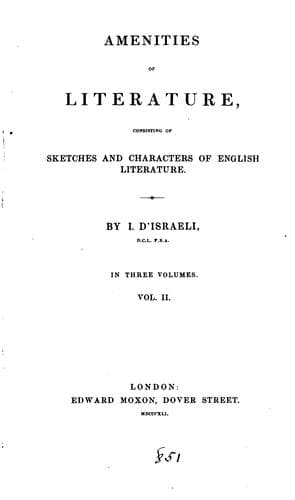
Amenities of Literature: Consisting of Sketches and Characters of English LiteratureDisraeli, Isaac
History
Amenities of Literature: Consisting of Sketches and Characters of English Literature
Disraeli, Isaac
Authors, English -- Biography; English literature -- History and criticism; Great Britain -- Intellectual life
A striking contrast is observable among those who by their secluded
position have held little intercourse with their neighbours, and have
contracted an overweening estimation of themselves, and a provincial
pride in their customs, manners, and language. Norfolk, surrounded on
three sides by the sea, remains unaltered to this day, and still
designates as "Shiremen" all who are born out of Norfolk, not without
"some little expression of contempt." There is "a narrowness and tenuity
in their pronunciation," such as we may fancy--for it is but a
fancy--would steal out of the lips of reserved, proudful men, and who,
as their neighbours of Suffolk run their common talk into strange
melancholy cadences, have characterised their peculiar intonation as
"the Suffolk whine!" In Derbyshire the pronunciation is broad, and they
change the G into K. The Lancashire folk speak quick and curt, omit
letters, or sound three or four words all together; thus, _I
wou'didd'n_, or _I woudyedd'd_, is a cacophony which stands for _I wish
you would_! When the editor of a Devonshire dialect found that it was
aspersed as the most uncouth jargon in England, he appealed to the
Lancashire.[4]
But such vile rustic dissonance or mere balderdash concerns not our
vernacular literature, though it seems that even such agrestic rubbish
may have its utility in a provincial vocabulary; for the glossary to the
"Exmoor language" was drawn up for the use of lawyers on the western
circuit, who frequently mistook the evidence of a rustic witness for
want of an interpretation of his words. Some ludicrous misconceptions of
equivocal terms or some ridiculous phraseology have been recorded in
other counties, among the judges and the bar at a county assize.
But it is among our provincial dialects that we discover many beautiful
archaisms, scattered remnants of our language, which explain those
obscurities of our more ancient writers, singularities of phrase, or
lingual peculiarities, which have so often bewildered the most acute of
our commentators. After all their voluminous research and their
conjectural temerity, a villager in Devonshire or in Suffolk, and, more
than either, the remoter native of the North Countree, with their common
speech, might have recovered the baffled commentators from their agony.
The corrections of modern editors have often been discovered to be only
ingenious corruptions of their own whenever the original provincial
idiom has started up.
Public-domain text, read in full here on John Shaqi.
Reviews
Reviews
No reviews yet
Be the first to share your thoughts on this work.
Elsewhere in the archive
Join the Discussion
Join the discussion
Sign in to leave a comment or review.
Sign InorCreate an account