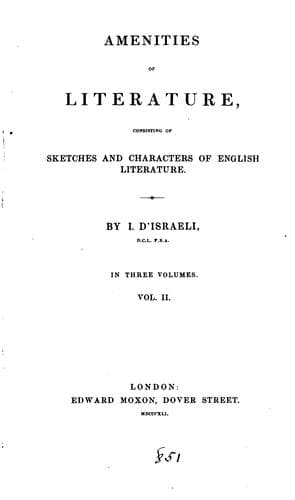
Amenities of Literature: Consisting of Sketches and Characters of English LiteratureDisraeli, Isaac
History
Amenities of Literature: Consisting of Sketches and Characters of English Literature
Disraeli, Isaac
Authors, English -- Biography; English literature -- History and criticism; Great Britain -- Intellectual life
These provincial modes of speech have often actually preserved for us
the origin of English phraseology, and enlightened the philologist in a
path unexplored. In one of the most original and most fanciful of the
dramas of Ben Jonson, "The Sad Shepherd," the poet designed to
appropriate a provincial dialect to the Witch Maudlin's family. He had
consulted Lacy the comedian, who was a native of Yorkshire, respecting
the northern phraseology. Unfortunately, this drama was never finished;
and the consequence is, that the dialects are incorrectly given, and are
worsened by the orthography of the printer. Yet it was from this
imperfect attempt to convey some notion of our dialects that Horne Tooke
was able to elucidate one of his grammatical discoveries, in regard to
the conjunction IF, which, from "The Sad Shepherd," is demonstrated to
be anciently the imperative of the verb GIF, or give. Thus it was, by
apparently very rude dialects, this famous philologist was enabled to
substantiate beyond doubt a signification which had occurred to no one
but himself.[5]
A language in the progress of its refinement loses as well as gains in
the amount of words, and the good fortune of expressive phrases. Some
become equivocal by changing their signification, and some fall
obsolete, one cannot tell why, for custom or caprice arbitrate, guided
by no law, and often with an unmusical ear. These discarded but faithful
servants, now treated as outcasts, and not even suspected to have any
habitation, are safely lodged in some of our dialects. As the people are
faithful traditionists, repeating the words of their forefathers, and
are the longest to preserve their customs, they are the most certain
antiquaries; and their oral knowledge and their ancient observances
often elucidate many an archæological obscurity. Hence, two remarkable
consequences have been discovered in the history of our popular idioms;
many words and phrases used in the land of Cockney, now deemed not only
vulgar but ungrammatical, are in fact not corruptions of the native
tongue, but the remains of what was anciently at different periods the
established national dialect.[6] This transmitted language descended to
the humbler classes, unimpaired and unaugmented, through a long line of
ancestry. Again, it is often probable that the provincial word which in
its pronunciation merely reverses the order of the letters, as now
uttered, and which is only heard from the mouths of the people, may
convey the original spoken sound, and be the genuine English. Are we
quite sure that the polishers may not often have been the corrupters of
our language? Nor let us be positive that the metropolitan taste has
always fixed on the most felicitous or the most forcible of our
idiomatic words or phrases, since we may discover some lingering among
our provincial dialects which should never have been dismissed, and
which claim to be restored. When JOHNSON compiled his "Dictionary," he
Public-domain text, read in full here on John Shaqi.
Reviews
Reviews
No reviews yet
Be the first to share your thoughts on this work.
Elsewhere in the archive
Join the Discussion
Join the discussion
Sign in to leave a comment or review.
Sign InorCreate an account