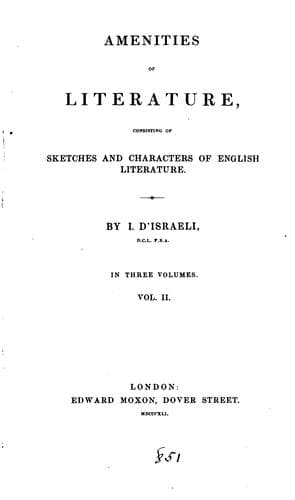
Amenities of Literature: Consisting of Sketches and Characters of English LiteratureDisraeli, Isaac
History
Amenities of Literature: Consisting of Sketches and Characters of English Literature
Disraeli, Isaac
Authors, English -- Biography; English literature -- History and criticism; Great Britain -- Intellectual life
Mandeville first composed his travels in the Latin language, which he
afterwards translated into French, and lastly out of French into
English, that "every man of my nation may understand it." We see the
progressive estimation of the languages by this curious statement which
Mandeville has himself given. The author first secured the existence of
his work in a language familiar to the whole European world; the French
was addressed to the politer circles of society; and the last language
the author cared about was the vernacular idiom, which, at that time the
least regarded, required all the patriotism of the writer in this
devotion of his pen.
Copies of these travels were multiplied till they almost equalled in
number those of the Scriptures; now we may smile at the "mervayles" of
the fourteenth century, and of Mandeville, but it was the spirit of
these intrepid and credulous minds which has marched us through the
universe. To the children of imagination perhaps we owe the
circumnavigation of the globe and the universal intercourse of
nations.[2]
FOOTNOTES:
[1] CTESIAS, a physician in high repute at the Persian Court, and
often referred to by Diodorus. He has been universally condemned as a
fabulous writer, to which charge his descriptions of some animals was
liable. But a naturalist of the highest order, the famous CUVIER, has
perhaps done an act of justice to this fabricator of animals. Ctesias
reported the mythological creations which he had witnessed in
hieroglyphical representations as actual living animals. It is
glorious to remove from the darkened name of a writer, unjustly
condemned, the obloquy of two thousand years.--"Theory of the Earth,"
translated by Professor Jameson, 76.
[2] Of modern editions of Mandeville's "Travels in England," that of
1725, printed by Bowyer, is a large octavo. There are numerous
manuscripts of Mandeville in existence. An edition collated might
discover either omissions or interpolations. This might serve as the
labour of an amateur. Mandeville has not had the fortune of his
predecessor Marco Polo, to have met with a Marsden, learned in
geographical and literary illustration.
Long subsequently to the time that this article was written, this
edition of 1725 has been reprinted, with the advantage of a
bibliographical introduction by Mr. Halliwell, and a collation of
texts. [It was published in 1839, in an octavo volume of 326 pages,
with illustrative engravings from manuscripts and printed books.]
CHAUCER.
Public-domain text, read in full here on John Shaqi.
Reviews
Reviews
No reviews yet
Be the first to share your thoughts on this work.
Elsewhere in the archive
Join the Discussion
Join the discussion
Sign in to leave a comment or review.
Sign InorCreate an account