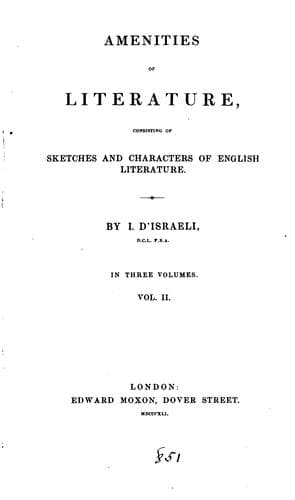
Amenities of Literature: Consisting of Sketches and Characters of English LiteratureDisraeli, Isaac
History
Amenities of Literature: Consisting of Sketches and Characters of English Literature
Disraeli, Isaac
Authors, English -- Biography; English literature -- History and criticism; Great Britain -- Intellectual life
In the chronology of our poetical collectors, GOWER takes precedence of
CHAUCER unjustly, for Chaucer had composed many of his works in the only
language which he has written before the elder claimed the honours of an
English vernacular poet, and, probably, then only emulating the success
of him who first set the glorious example. Nor less in the rank of
poetry must Chaucer hold the precedence. The first true English poet is
Chaucer; and notwithstanding that the rhythmical cadences of his unequal
metre are now lost for us, Chaucer is the first modeller of the heroic
couplet and other varieties of English versification. By the felicity of
his poetic character, Chaucer was not only the parent, but the master,
of those two schools of poetry which still divide its votaries by an
idle rivalry, and which have been traced, like our architecture, the one
to a Gothic origin, and the other to a classical model.
The personal history of CHAUCER, poetical and political, might have been
susceptible of considerable development had the poet himself written it,
for his biographers had no life to record. Speght, one of the early
editors, in the good method of that day, having set down a variety of
heads, including all that we might wish to know of any man, when this
methodiser of commonplaces came to fill up these well-planned divisions
concerning Chaucer, he could only disprove what was accepted, and supply
only what is uncertain. The "Life of Chaucer" by Godwin is a theoretical
life, and, as much as relates to Chaucer himself, a single fatal fact,
when all was finished, dispersed the baseless vision.[1] The whole
rested on the unauthenticated and contradictory statements of Leland,
who, writing a century after the times of Chaucer, hastily collected
unsubstantial traditions, and, what was less pardonable in Leland, fell
into some anachronisms.
Public-domain text, read in full here on John Shaqi.
Reviews
Reviews
No reviews yet
Be the first to share your thoughts on this work.
Elsewhere in the archive
Join the Discussion
Join the discussion
Sign in to leave a comment or review.
Sign InorCreate an account