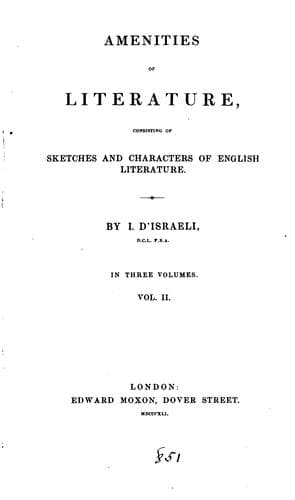
Amenities of Literature: Consisting of Sketches and Characters of English LiteratureDisraeli, Isaac
History
Amenities of Literature: Consisting of Sketches and Characters of English Literature
Disraeli, Isaac
Authors, English -- Biography; English literature -- History and criticism; Great Britain -- Intellectual life
We may doubt if the vernal scenes of Chaucer can be partaken by his more
chilly posterity. Did England in the seasons of Chaucer flourish with a
more genial May and a more refulgent June? Or should we suspect that the
travelled poet clothed our soil with the luxuriance of Provençal fancy,
and borrowed the clear azure of Italy to soften the British roughness
even of our skies?
Tyrwhit, the able commentator of Chaucer, has thrown out an incidental
remark, which seems equally refined and true. "Chaucer in his serious
pieces often follows his author with the servility of a mere translator;
and in consequence his narration is jejune and constrained (as often
appears in the "Romaunt of the Rose" and his translations of Dante),
whereas in the comic he is generally satisfied with borrowing a slight
hint of his subject, which he varies, enlarges, and embellishes at
pleasure, and gives the whole the air and colour of an original; a sure
sign that his genius rather led him to compositions of the latter kind."
This remark is an instance of critical sagacity. The creative faculty in
Chaucer had not broken forth in his translations, which evidently were
his earliest writings. The native bent of his genius, the hilarity of
his temper, betrays itself by playful strokes of raillery and concealed
satire when least expected. His fine irony may have sometimes left his
commendations, or even the objects of his admiration, in a very
ambiguous condition. The learned editor of the second part of the
"Paston Letters" hence has been induced to infer that the spirit of
chivalry, from the reign of the third Edward, had entirely declined, and
only existed in the forms of conventional and fashionable society, and
had sunk into a mere foppery, a system of forms and etiquettes, because
Chaucer, a court-poet, treats with irony the chivalric manners. Whether
this ingenious inference will hold with literary antiquaries, I will not
decide; but I am inclined to suspect that Chaucer's indulgence of his
taste for irony was not in the mind of this learned editor. Our poet has
stamped with his immortal ridicule the tale told in his own person--"The
Rime of Sir Thopas," which is considered as a burlesque of the metrical
romances. In those days there was an inundation of these romances, as
"the thirst and hunger" of the present is accommodated with as spurious
a brood. We have our "drafty prose" as they had their "drafty riming."
But shall we infer from this ludicrous effusion of the great poet, that
he held so light the venerable fablers, the ancient romancers, with
whose "better parts" he had nourished his own genius? This is his own
confession. Often in his years of grief, when the poet wondered
How he lived, for day ne night,
I may not sleep--
Sitting upright in my bed,
then it was that he prescribed for his "secret sorrows" that medicine
which, "drunk deeply," makes us forget ourselves. In those hours the
poet
Public-domain text, read in full here on John Shaqi.
Reviews
Reviews
No reviews yet
Be the first to share your thoughts on this work.
Elsewhere in the archive
Join the Discussion
Join the discussion
Sign in to leave a comment or review.
Sign InorCreate an account