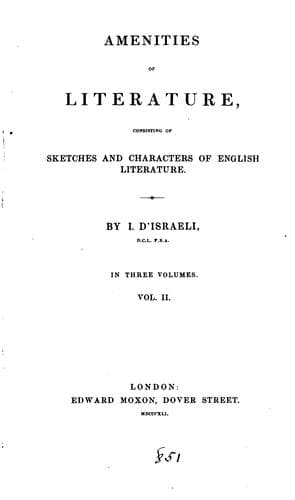
Amenities of Literature: Consisting of Sketches and Characters of English LiteratureDisraeli, Isaac
History
Amenities of Literature: Consisting of Sketches and Characters of English Literature
Disraeli, Isaac
Authors, English -- Biography; English literature -- History and criticism; Great Britain -- Intellectual life
The island of Britain, itself not extensive, was broken into petty
principalities: we are told that there were nearly two hundred
kinglings, the greater part of whom did not presume to wear crowns.
Sometimes they united in their jealousies of some paramount tyrant, but
they raged among themselves; and the passion of Gildas has figured them
as "the Lioness of Devonshire" encountering a "Lion's Whelp" in
Dorsetshire, and "the Bear-baiter," trembling before his regal brother,
"the Great Bull-dog." "These kings were not appointed by God," exclaims
the British Jeremiah; he who wrote under the name of Gildas. Thus the
Britons formed a powerless aggregate, and never a nation. The naked
Irish haunted their shores, covering their sea with piracy; and the
Picts rushed from their forests--giants of the North who, if Gildas does
not exaggerate, even dragged down from their walls the amazed Britons.
Such a people in their terrified councils were to be suppliants to the
valour of foreigners; from that hour they were doomed to be chased from
their natal soil. They invited, or they encouraged, another race to
become their mercenaries or their allies. The small and the great from
other shores hastened to a new dominion. Britain then became "a field of
fortune to every adventurer when nothing less than kingdoms were the
prize of every fortunate commander."[4]
We have now the history of a people whose enemies inhabited their
ancient land: the flame and the sword ceaselessly devouring the soil;
their dominion shrinking in space, and the people diminishing in number;
victory for them was fatal as defeat. The disasters of the Britons
pursued them through the despair of almost two centuries; it would have
been the history of a whole people ever retreating, yet hardly in
flight, had it been written. Shall we refuse, on the score of their
disputed antiquity the evidence of the Welsh bards? The wild grandeur of
the melancholy poetry of those ancient Britons attests the reality of
their story and the depth of their emotions.[5]
We have spun the last thread of our cobweb, and we know not on what
points it hangs, such irreconcileable hypotheses are offered to us by
our learned antiquaries, whenever they would account for the origin or
the disappearance of a whole people. The mystery deepens, and the
confusion darkens amid contradictions and incredibilities, when the
British historian contemplates in the perspective the Fata Morgana of
another Britain on the opposite shores of the ancient Armorica, another
Britain in La Brétagne.
The ancient Armorica was a district extending from the Loire to the
Seine, about sixty leagues, and except on the land side, which joined
Poictou, is encircled by the ocean. Composed of several small states, in
the decline of the Roman empire they shook off the Roman yoke, and their
independence was secured by the obscurity of their sequestered locality.
Public-domain text, read in full here on John Shaqi.
Reviews
Reviews
No reviews yet
Be the first to share your thoughts on this work.
Join the Discussion
Join the discussion
Sign in to leave a comment or review.
Sign InorCreate an account