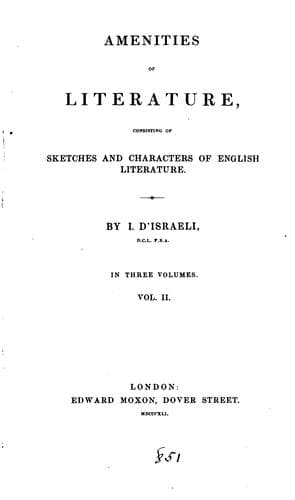
Amenities of Literature: Consisting of Sketches and Characters of English LiteratureDisraeli, Isaac
History
Amenities of Literature: Consisting of Sketches and Characters of English Literature
Disraeli, Isaac
Authors, English -- Biography; English literature -- History and criticism; Great Britain -- Intellectual life
That the native term of _Brith_ or _Brithon_, by its curt harshness,
would clash on the modulating ear of the Greek voyager, or the Latin
poet, seems probable, for by them it was amplified. And thus we owe to
sonorous antiquity the name now famous as their own, for BRITANNIA first
appeared in their writings, bequeathed to us by the masters of the world
as their legacy of glory.
To the knowledge of the Romans the island exceeded in magnitude all
other islands; and they looked on this land with pride and anxiety,
while they dignified Britain as the "Roman island." The Romans even
personified the insular Genius with poetic conceptions. Britannia is
represented as a female seated on a rock, armed with a spear, or leaning
on a prow, while the ship beside her attests her naval power. We may yet
be susceptible of the prophetic flattery, when we observe the Roman has
also seated her on a globe, with the symbol of military power, and the
ocean rolling under her feet.[3]
The tale of these ancient Britons who should have been our ancestors is
told by the philosophical historian of antiquity. Under successive Roman
governors they still remained divided by native factions: "A
circumstance," observes Tacitus, "most useful for us, among such a
powerful people, where each combating singly, all are subdued." A
century, as we have said, had not elapsed from the landing of Cæsar to
the administration of Agricola. That enlightened general changed the
policy of former governors; he allured the Britons from their forest
retreats and reedy roofs to partake of the pleasures of a Roman city--to
dwell in houses, to erect lofty temples, and to indulge in dissolving
baths. The barbarian who had scorned the Roman tongue now felt the
ambition of Roman eloquence; and the painted Briton of Cæsar was
enveloped in the Roman toga. Severus, in another century after Agricola,
as an extraordinary evidence of his successful government, appealed to
Britain--"Even the Britons are quiet!" exclaimed the emperor. The
tutelary genius of Rome through four centuries preserved Britain--even
from the Britons themselves; but the Roman policy was fatal to the
national character, and when the day arrived that their protector
forsook them, the Britons were left among their ancient discords: for
provincial jealousies, however concealed by circumstances, are never
suppressed; the fire lives in its embers ready to be kindled.
Public-domain text, read in full here on John Shaqi.
Reviews
Reviews
No reviews yet
Be the first to share your thoughts on this work.
Join the Discussion
Join the discussion
Sign in to leave a comment or review.
Sign InorCreate an account