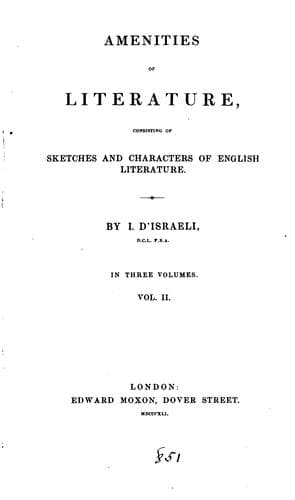
Amenities of Literature: Consisting of Sketches and Characters of English LiteratureDisraeli, Isaac
History
Amenities of Literature: Consisting of Sketches and Characters of English Literature
Disraeli, Isaac
Authors, English -- Biography; English literature -- History and criticism; Great Britain -- Intellectual life
--------Whoso list not to hear,
Turn over the leaf, and chese another tale!
Our notions and our customs of delicacy are the result of a change in
our manners of no distant period; and, compared with our neighbours,
many are still but conventional. They are so even in respect to
ourselves, for, not to go back to the golden days of Elizabeth, the
language and the manners of the court of Anne would have startled modern
decorum. The "polite conversation" of Swift has fortunately preserved
for us specimens which we could not have imagined. Our poems, our
comedies, and our tales, so late as the days of Swift and Pope, have
allusions, and even incidents and descriptions, which we no longer
tolerate. How far our fastidiousness lies on the surface of our lesser
morals, I will not decide; but men of genius have complained that this
fastidiousness has become too restrictive, by contracting the sphere of
inventive humour, which flashes often in such small matters as ludicrous
tales and playful levities, which must not lie on our tables.
Chaucer long remained a favourite in the most polite circles; Aubrey, at
the close of the seventeenth century, in his "Idea," recommends the
study of Chaucer, as the poet in full reputation. At a later period, the
days of Dryden and Pope, our versifiers were continually renovating his
humour and his more elegant fictions. OGLE, with others, attempted to
modernize Chaucer; but it is as impossible to give such a version of
Chaucer as to translate the Odes of Horace. They corrupted by their
interpolations, and weakened by their diffusion; Chaucer was not
discernible in the dimness of their paraphrase. The great beauties of
Chaucer spring up from the soil in which they lie embedded; and the most
skilful hand will discover that in gathering the flower it must cease to
live without its root.
Public-domain text, read in full here on John Shaqi.
Reviews
Reviews
No reviews yet
Be the first to share your thoughts on this work.
Elsewhere in the archive
Join the Discussion
Join the discussion
Sign in to leave a comment or review.
Sign InorCreate an account