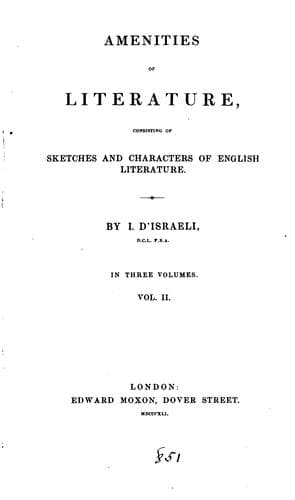
Amenities of Literature: Consisting of Sketches and Characters of English LiteratureDisraeli, Isaac
History
Amenities of Literature: Consisting of Sketches and Characters of English Literature
Disraeli, Isaac
Authors, English -- Biography; English literature -- History and criticism; Great Britain -- Intellectual life
The famous portion of Chaucer's Miscellaneous Volume has been fortunate
in the editorial cares of TYRWHIT. Tyrwhit, a scholar as well as an
antiquary, was an expert philologer; his extensive reading in the lore
of our vernacular literature and our national antiquities promptly
supplied what could not have entered into his more classical studies;
and his sagacity seems to have decided on the various readings of all
the manuscripts, by piercing into the core of the poet's thoughts.[8]
It is remarkable that some of the most lively productions of several
great writers have been the work of their maturest age. Johnson
surpassed all his preceding labours in his last work, the popular Lives
of the Poets. The "Canterbury Tales" of Chaucer were the effusions of
his advanced age, and the congenial verses of Dryden were thrown out in
the luxuriance of his later days. Milton might have been classed among
the minor poets had he not lived to be old enough to become the most
sublime. Let it be a source of consolation, if not of triumph, in a long
studious life of true genius, to know that the imagination may not
decline with the vigour of the frame which holds it; there has been no
old age for many men of genius.
We must lament that at such an early period in our vernacular
literature, we have to record that the two fathers of our poetry,
congenial spirits as they were, too closely resembled most of their
sons--in one of the most painful infirmities of genius. I have said
elsewhere that jealousy, long supposed to be the offspring of little
minds, is not, however, confined to them. We do not possess the secret
history of the two great poets, Chaucer and Gower; but we are told by
Berthelet in his edition of Gower's "Confessio Amantis," when he quotes
the commendatory lines on Gower by Chaucer, that the poets "were both
excellently learned, _both great friendes together_." Ancient
biographers usually fall into this vague style of eulogy, which served
their purpose rather than a more critical research. True it is that
"they were both great friends," but, what Berthelet has not told, they
became also "both great enemies." We know that Chaucer has commemorated
the dignified merits of "the moral Gower," and that Gower has poured
forth an effusion not less fervid than elegant from the lips of Venus,
who calls Chaucer "her own clerk, who in the flower of his youth had
made ditees and songes glad which have filled the land." Did this little
passion of poetic jealousy creep into their great souls? Else how did it
happen that Chaucer, who had once solicited the correcting hand of his
friend, in his latest work, reprehended the sage and the poet, and that
Gower, who had not stinted the rich meed of his eulogy which appeared in
the first copies of his "Confessio Amantis," erased the immortality
which he had bestowed. The justice of their reciprocal praise neither of
these rivals could efface, for that outlives their little jealousies.
FOOTNOTES:
Public-domain text, read in full here on John Shaqi.
Reviews
Reviews
No reviews yet
Be the first to share your thoughts on this work.
Elsewhere in the archive
Join the Discussion
Join the discussion
Sign in to leave a comment or review.
Sign InorCreate an account